


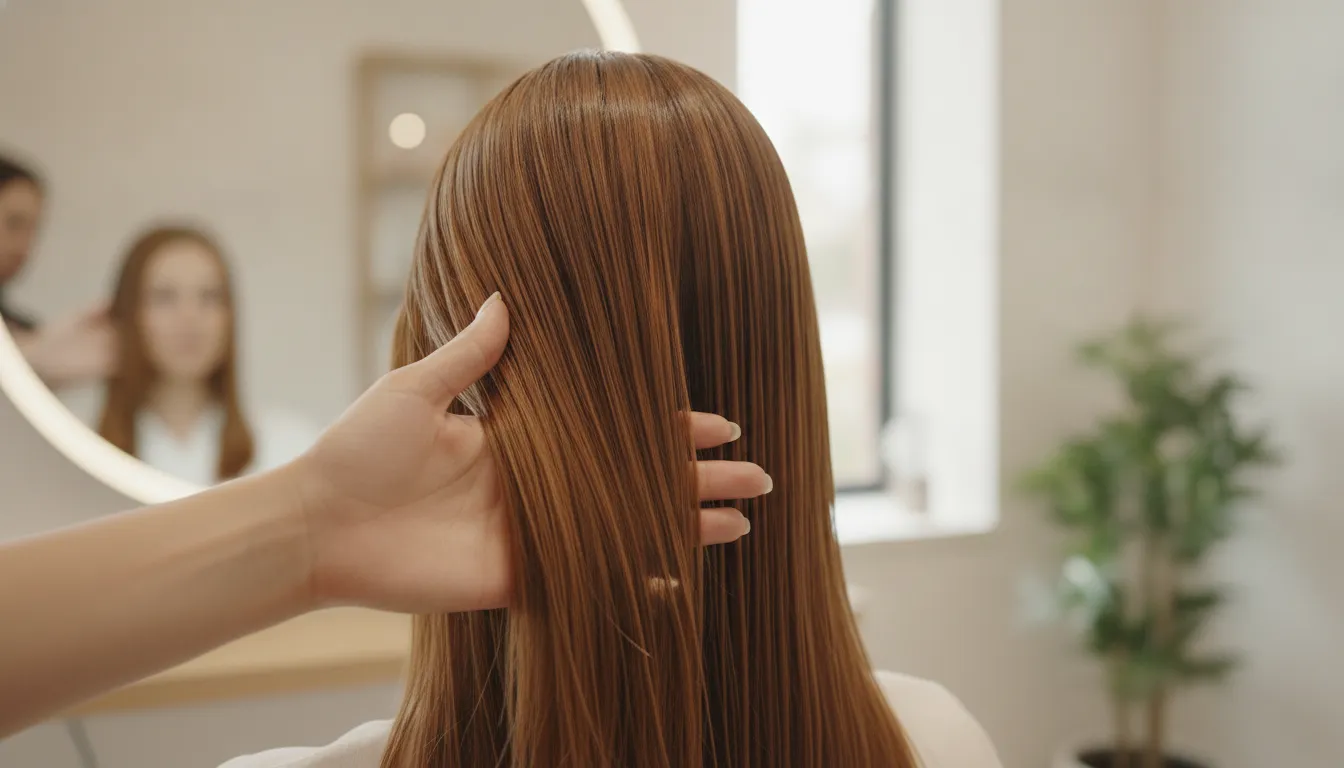
Color, heat, brushing, and time can leave hair feeling rough because damage affects more than the surface. The bonds supporting keratin fibers help determine how strong and flexible each strand feels, and cosmetic, mechanical, or thermal stress can alter that balance.
A hair bond repair treatment helps reconnect or support broken bonds within the hair cortex, improving the strand’s internal structure and behavior. Because hair damage is not limited to one bond type, the most considered approach looks beyond disulfide bonds alone. Solanesse goes further with a complete-structure focus that includes the cuticle, cortex, and cell membrane complex, making its Deep Conditioner Post Color Revitalizer a simple post-color repair ritual.
Understanding what happens inside the strand makes it easier to choose a treatment that matches the kind of damage your hair is experiencing. Rather than relying on a one-size-fits-all promise.
Try the Deep Conditioner Post Color Revitalizer for your post-color repair ritual.
What a Hair Bond Repair Treatment Actually Does
A hair bond repair treatment helps reinforce the internal structure that gives each strand strength, flexibility, and integrity. Rather than coating the surface alone, it is designed to support the bonds within the hair fiber that can become compromised by coloring, heat, and mechanical stress.
Hair is not a simple solid filament. Its main structural protein, keratin, relies on several types of bonds working together. Hydrogen bonds contribute to the fiber’s shape and behavior, ionic bonds help support its internal organization, and disulfide bonds provide important strength within the keratin network. A treatment that supports bond repair is therefore addressing a structural system, not simply adding temporary softness.
This distinction matters after chemical services. Hair color can alter the fiber’s environment, while repeated brushing, heat styling, and everyday friction add mechanical and thermal stress. Over time, these pressures may change how the strand responds to moisture, tension, and styling. The result can be hair that feels rough, weak, overly elastic, or less manageable than it did before.
Why disulfide bonds are only part of the picture
Disulfide bonds receive considerable attention because they are important to the strength and integrity of keratin fibers. However, they are not distributed uniformly throughout the hair. Research describes different types of disulfide bonds according to their location within the fiber and how they respond to chemical agents. That variation means damage does not occur in one identical pattern across every strand.
The broader science supports a more precise view of repair. Hair keratin’s mechanical properties come from the combined contribution of hydrogen, disulfide, and ionic bonds, rather than from one bond type acting alone. You can read the underlying research in the PubMed review of chemical bonding in hair.
In practical terms, bond repair is about helping damaged hair recover a more cohesive internal feel. It cannot turn a permanently damaged length into untouched virgin hair, and it does not replace careful handling. It can, however, form part of a thoughtful post-color ritual that supports the strand where stress has accumulated. The most considered formulas look beyond one molecular target and address the hair as a complete structure. Including the outer cuticle and the inner regions that influence strength, smoothness, and resilience.
How Bond Builders Rebuild Damaged Strands
Bond builders work inside the hair fiber by helping stabilize the connections that give the cortex its strength and flexibility. When coloring, heat, brushing, and styling disturb those connections, targeted repair ingredients can help support the strand as it regains a more cohesive structure.
What stress changes inside the cortex
The cortex is the inner body of the hair, made largely of keratin fibers. Its mechanical behavior does not depend on one bond alone. Hydrogen, disulfide, and ionic bonds all contribute to the integrity and performance of keratin fibers, according to a review indexed by PubMed. The research explains how these bonds contribute to hair structure.
Coloring can place chemical stress on the fiber, while hot tools expose it to thermal stress. Wet-to-dry styling, brushing, detangling, and tension from clips or elastics add mechanical stress. These forces can break or alter bonds and change the balance between disulfide and hydrogen bonding, as well as other interactions that influence how hair behaves. The result may be a strand that feels rougher, weaker, less elastic, or more difficult to manage.
How bond builders support repair
A bond-building formula is designed to work with the damaged fiber rather than simply coating its surface. Depending on the chemistry, its ingredients may help reconnect, reinforce, or stabilize disrupted interactions within the cortex. This does not mean that every damaged bond is restored in exactly the same way. Hair is a complex biological material, and the response depends on the type, location, and extent of the damage.
Disulfide bonds are not a single uniform category. They occur in different forms and can respond differently to chemical agents depending on where they sit within the fiber. That distinction matters because a treatment aimed at one bond type may not address every factor behind brittle, porous, or unruly hair. Effective hair bond repair treatment should therefore be understood as structural support, not a promise to reverse every effect of processing in one use.
Why whole-strand care matters
Bond repair is most useful when it sits within a broader approach to strand care. The cortex may need bond support, while the cuticle needs smoothness and the cell membrane complex needs protection for the hair to feel healthy and behave well. This is why Solanesse takes a complete-structure perspective. Explore the science behind bond repair to see how the treatment approach connects bond support with the wider architecture of the hair fiber.
The practical takeaway is simple: chemical, thermal, and mechanical stress can affect the internal systems that hold hair together. Bond builders help reinforce those systems, while a complete repair ritual helps address how the strand feels, functions, and responds to future styling.
Does Hair Bond Repair Really Work?
Yes, bond repair treatments can improve the feel and performance of damaged hair when their active ingredients reach the hair fiber and support its weakened structure. They are especially relevant after chemical processing, when changes to the bonds within keratin fibers can affect strength, flexibility, and manageability.
That answer needs a little precision. A treatment cannot restore every aspect of heavily damaged hair in one use, and the word repair does not mean that every broken bond is permanently returned to its original state. The meaningful question is whether the formula addresses a real source of damage and produces observable improvements in the strand.
What the evidence tells us
Hair keratin gets its structural integrity and mechanical properties from several types of interaction, including hydrogen, disulfide, and ionic bonds. Chemical agents, mechanical stress, and heat can break or alter these bonds, changing how the fiber behaves. Research summarized in this PubMed review of hair fiber chemistry explains that bond disruption can affect the balance of forces that contribute to hair strength and behavior.
This matters because damage is not simply a surface problem. If a strand becomes rougher, weaker, more brittle, or harder to style after bleaching, coloring. Or repeated heat exposure, those changes reflect alterations within the fiber as well as at the cuticle. A well-designed bond repair treatment may help reinforce or condition compromised areas, reducing the signs associated with that stress.
Why formulas are not interchangeable
Disulfide bonds are important, but they are not identical throughout the hair fiber. The research notes that they can differ according to their location and how they respond to chemical agents. That variation helps explain why two products marketed for bond repair may create different results on the same head of hair. Performance depends on the active technology, the level and type of damage, how the product is used, and what else the formula does for the strand.
Consumer bond repair became widely recognized through products such as Olaplex, which helped introduce the category to home users. K18 brought a different point of emphasis with a biomimetic peptide approach. These examples provide useful differentiation context, but neither category label alone proves that a treatment will suit every type of damage.
For color-treated hair, the most credible approach is to look beyond a single bond claim and assess the whole fiber. Solanesse takes that broader position by designing its Deep Conditioner Post Color Revitalizer to address the cuticle. Cortex, and cell membrane complex, rather than focusing exclusively on disulfide bonds. The result is a more complete repair ritual for hair that needs both structural support and a smoother, more conditioned finish.
Hair Bond Repair vs Whole-Structure Repair
A bond repair treatment can help reinforce damaged areas by focusing on bonds within the hair fiber, especially disulfide bonds. That is a meaningful part of hair repair, but it is not the complete structure. Solanesse takes a broader approach, addressing the cuticle, cortex, and cell membrane complex in one post-color treatment.
The distinction matters when hair feels rough, porous, weak, or difficult to style after repeated chemical and heat exposure. Hair keratin depends on hydrogen, disulfide, and ionic bonds for its structural integrity, and those bonds do not all respond to stress in the same way. Research on the bonding structure of keratin fibers describes disulfide bonds as varied according to their location and responsiveness to chemical agents. A treatment that considers the full fiber can therefore support more than one layer of the damage experience.
| Bond-only repair | Whole-structure repair (Solanesse) |
|---|---|
| Primarily targets disulfide bonds within the hair fiber. | Addresses the cuticle, cortex, and cell membrane complex. |
| Helps focus the repair conversation on internal bond strength, as with traditional bond-building treatments such as Olaplex. | Looks at the complete hair structure so the surface and inner fiber are treated as connected parts of the strand. |
| May be useful when the main concern is weakened internal bonding after chemical stress. | Is designed for the broader post-color experience, including compromised smoothness, manageability, and structural feel. |
| Can require a multi-step routine depending on the product system. | Offers a single-step, clean-clinical ritual for salon-quality care at home. |
Whole-structure repair does not make bond repair irrelevant. It places bond support in context. The cortex gives hair much of its strength and shape, while the cuticle helps protect the fiber and influence how it feels and behaves. The cell membrane complex helps connect the structural layers. Treating only one area can leave other contributors to dryness, friction, and porosity unaddressed.
For color-treated hair, this broader scope is especially practical. Chemical processing, mechanical handling, and heat can alter the balance of bonds and change hair behavior. A complete repair ritual is intended to meet the strand where the damage is felt, without asking you to build an elaborate regimen around it.
Try the bond-rebuilding Deep Conditioner
Solanesse Deep Conditioner – Post Color Revitalizer is available for $39. Use it as a focused post-color ritual when you want a more comprehensive approach than disulfide-bond support alone.
How Often Should You Use a Bond Repair Treatment?
For women who color their hair every 6 to 8 weeks, a weekly or every-other-wash bond and structure repair ritual is a practical starting point. That cadence helps support the hair between appointments, when repeated chemical services can contribute to cumulative structural damage. The goal is consistent maintenance, not an intensive treatment every day.
Coloring is only one part of the equation. Heat styling, brushing, and environmental exposure can also place stress on the hair over time. A well-timed hair bond repair treatment fits into your existing wash routine, helping make repair a steady habit rather than another complicated project.
A simple cadence for color-treated hair
- After each color service: Use a restorative treatment as part of your first or next wash, following the product directions. This gives the hair focused care after a predictable period of chemical stress.
- Weekly maintenance: Apply a bond and structure repair treatment once a week if you wash several times weekly or notice increasing dryness, roughness, or loss of manageability.
- Every other wash: Choose this schedule when your hair is visibly fragile, frequently heat styled, or prone to tangling. Reduce the frequency if your hair feels weighed down or your product directions specify less frequent use.
- As needed around heat styling: If you regularly use a blow dryer, flat iron, or curling tool, maintain a consistent repair rhythm and pair it with appropriate heat protection. Repair care does not replace heat protection.
There is no universal number that suits every head of hair. Fine hair may need a lighter or less frequent application, while porous, chemically treated hair may benefit from more regular support. Pay attention to how your strands feel after washing and styling. Improved softness and manageability suggest the routine is working well; limpness or buildup suggests it is time to adjust the amount or spacing.
Convenience matters because a ritual only supports the hair when it is used consistently. An at-home, one-step treatment can be easier to maintain than a multi-product system, particularly for women balancing regular salon appointments with daily routines. For a broader recovery plan, see our guide to how to fix damaged hair after coloring.
Think of the schedule as preventive maintenance between color appointments. Start with weekly use or every other wash, reassess after two to three weeks, and refine the cadence according to your hair’s texture, processing history, and response.
What to Look For in a Bond Repair Treatment for Color-Treated Hair
Color-treated hair needs more than a treatment that sounds advanced. After repeated chemical services, the fiber can feel rough at the surface while also losing resilience deeper inside the strand. The most useful formula is one that respects both realities: it should help support the bonds that contribute to strength and address the surrounding structures that influence softness. Shine, and manageability.
Start by looking for a treatment with a clearly defined repair scope. Hair is not made of one type of bond or one uniform layer. Its performance depends on the relationship between the cuticle, cortex, and cell membrane complex. A bond repair treatment that considers the complete structure offers a more thoughtful approach for hair that has been lightened, colored, heat-styled, or exposed to repeated mechanical stress.
Choose full-structure support
Disulfide bonds are important, but they are not the entire story. The cuticle forms the protective outer surface, the cortex contributes much of the strand’s strength and body, and the cell membrane complex helps hold adjacent components together. Solanesse Deep Conditioner – Post Color Revitalizer is designed around this complete structure rather than a narrow focus on disulfide bonds. Its clean-clinical positioning makes it a suitable fit for a post-color repair ritual that aims to improve the feel and appearance of the whole strand.
This broader perspective matters when your concerns are mixed. If hair looks dull, feels coarse, tangles easily, and snaps more readily, a bond-only message may not fully describe what needs attention. Look for language that explains how the product supports the hair fiber as a system, without promising to reverse every form of damage instantly.
Keep the ritual simple enough to repeat
The best treatment is one you can use consistently after the services that challenge your hair most. A single-step, at-home ritual can be easier to maintain than a complex sequence of products. Particularly for people who color their hair every six to eight weeks and want a dependable way to care for it between salon visits. Convenience should not replace substance, but it does make a science-backed routine more practical.
When comparing options, review the intended use, the treatment time, and whether the claims match your actual needs. Favor precise explanations over dramatic promises, and choose a formula that fits your preference for clean, clinical luxury. For a streamlined post-color routine, explore the bond-rebuilding Deep Conditioner. You can also use this guide on hair bond repair treatment as a practical next step when building a recovery plan after coloring.
Start your post-color repair ritual with the Deep Conditioner Post Color Revitalizer.
Frequently Asked Questions
What is a bond repair hair treatment?
A bond repair hair treatment is designed to support the internal connections that give keratin fibers strength and flexibility. Hair relies on hydrogen, disulfide, and ionic bonds, and chemical, thermal, or mechanical stress can alter them. A well-designed treatment should also address the surrounding structure, including the cuticle and the interfaces that help retain moisture and smoothness. Solanesse takes this whole-structure approach in its Deep Conditioner Post Color Revitalizer.
Does hair bond repair actually work?
It can improve the feel, manageability, and resilience of stressed hair when the formula and application match the type of damage. Bond repair is not a way to return severely compromised fibers to untouched hair, and it cannot replace careful coloring or trimming split ends. Research on keratin fibers shows that bond changes caused by chemical, mechanical, and thermal stress can alter hair behavior and strength: PubMed review.
What is the best hair bond repair treatment for color-treated hair?
The best option is one that fits your damage pattern and routine, rather than one that makes the biggest promise. For color-treated hair, look for support across the full structure: the cuticle, cortex, and cell membrane complex, not only one bond type. A single-step post-color conditioner can be especially practical if you want a consistent ritual without a complex multi-step system.
How often should you use a bond repair treatment on color-treated hair?
Use it according to the product directions and your hair’s condition, with extra attention after coloring or other processes that leave strands dry, rough, or fragile. If you color every 6 to 8 weeks, make repair part of the post-color routine and continue between appointments as needed. Adjust frequency if hair feels coated, heavy, or less responsive, and prioritize gentle handling between treatments.
Ready to Start Your Post-Color Repair Ritual?
A consistent post-color conditioning step can help your hair feel smoother, stronger, and more cared for between salon visits. Make the Solanesse Deep Conditioner Post Color Revitalizer part of your routine, especially when your strands need focused moisture and structural support after coloring. Try the Solanesse Deep Conditioner Post Color Revitalizer and get started with a considered repair ritual at home.


