



Color-treated hair can look glossy at the roots while the ends feel rough, catch on a brush, and appear thinner than the lengths above them. Those changes often reflect a mix of chemical processing, friction, heat, and normal wear. A thoughtful routine should improve softness without pretending that a topical product can reverse every form of damage.
Shop the Solanesse Post-Color Revitalizer
A split end repair treatment can condition and smooth damaged hair, reduce the visible look of fraying, and make detangling less abrasive. It cannot permanently fuse a physically separated fiber. When a split has traveled up the strand, a professional trim is the dependable way to remove that damaged section.
The distinction is useful because it gives you two practical goals. First, support the condition of the length you want to keep. Second, identify when the ends need cutting rather than another layer of product. The sections below explain what treatments can improve, how to care for color-treated hair, and how Solanesse fits into a post-color ritual.
What Can a Split End Repair Treatment Actually Do?
A split end repair treatment can lubricate the hair surface, improve slip, soften rough-feeling ends, and temporarily hold frayed fibers together so they look more cohesive. These effects support manageability and can reduce some daily friction. They are cosmetic and protective benefits, not a permanent reconstruction of a fiber that has already separated.
It can smooth the surface
Conditioning ingredients coat and lubricate the strand. This helps rough areas lie flatter and gives the hair more slip during rinsing, drying, and detangling. The immediate result may be softer ends, more shine, and fewer snags. For hair that has been colored or bleached, that improved slip can make routine handling feel gentler.
Smoothing is not the same as closing a split. A formula may make a forked tip harder to see for a while, but the split remains part of the physical fiber. As the conditioning effect fades or the hair meets more heat and friction, the same weakness can become visible again.
It can help protect the surrounding length
Less friction means fewer opportunities for a small weak point to catch, tangle, or experience additional breakage. Conditioning can therefore support the healthier length around an existing split. It works best alongside careful detangling, lower heat, and regular inspection of the ends.
Research on hair splitting describes combing and related forces as sources of longitudinal stress that can move damage along the strand. This academic research on hair splitting helps explain why better-conditioned hair may be easier to handle without claiming that treatment alone can erase an established split.
It cannot replace a trim
If the tip is visibly forked, the split continues upward, or the end remains rough after consistent conditioning, treatment is unlikely to resolve the problem. A trim removes the separated portion. You can then continue using a split end repair treatment to condition the fresh ends and reduce the chance of repeating the same cycle.
Why Color-Treated Hair Is More Prone to Visible Splitting
Color-treated hair is more likely to show roughness and splitting because chemical services can alter the fiber’s protective surface and reduce its tolerance for repeated stress. Bleaching is especially demanding, but permanent color, heat styling, brushing, washing, and friction against clothing can all add wear over time.
Bleaching changes the fiber’s response to stress
Bleach changes the hair rather than simply depositing color on the outside. A study of hair fiber behavior found that bleaching changed control hair so it resembled more damage-prone hair. The study’s findings on bleaching and split propagation provide context for why processed ends may deteriorate faster than untreated lengths.
Once the fiber is less resilient, everyday actions become more consequential. Pulling through a knot, rubbing wet lengths with a towel, pressing a hot tool repeatedly on the same area. Or wearing a tight style can lift roughened areas and extend weakness. A split end repair treatment can support the surface, but handling still matters.
Damage is not limited to the cuticle
The cuticle is the outer protective layer, but the cortex and cell membrane complex also contribute to the strand’s strength, flexibility, and feel. That is why a post-color routine should not focus only on shine. It should also support conditioning, elasticity, and manageability across the lengths.
Solanesse Post-Color Revitalizer is designed around the broader structure of the hair, including the cuticle, cortex, and cell membrane complex. Read more about Solanesse ingredients and hair structure to understand the brand’s approach. The goal is to support stressed hair without making a permanent split-repair promise.
Visible improvement has a clear limit
Conditioning can make a rough end feel more supple and appear less frayed. It cannot turn two separated sections of a hair fiber into one intact strand. Treat improvement in softness and manageability as a sign that your routine is supporting the hair, not as proof that a split has been permanently repaired.
If you are also managing broader post-color dryness, use this guide to repair damaged hair after coloring. A combined approach is more useful than relying on a single product claim.
Which Ingredients and Treatment Types Help Most?
The best treatment depends on the condition of the hair and the result you want. Conditioners improve slip and softness, proteins and peptides can support the feel of weakened strands, and oils can reduce surface friction. Each category has limits. No ingredient permanently reconnects a hair fiber that has already split.
| Type. | Helps with. | Limit. |
|---|---|---|
| Deep conditioner. | Slip and softness. | Cannot reconnect a split. |
| Proteins and peptides. | Feel of weak strands. | Cannot replace a trim. |
| Oils and serums. | Surface smoothness. | Cannot rebuild a divided tip. |
| Bond-focused products. | Support after chemical processing. | Cannot guarantee permanent repair. |
Conditioners and deep treatments
Rinse-out conditioners and deep treatments are the foundation of a lower-friction routine. They help the strands move past one another more easily, which matters when color-treated ends snag during detangling. A richer treatment can also improve the feel of dry lengths and make a polished style easier to maintain between trims.
Consistency matters more than a dramatic one-time application. The most useful formula is one that fits your wash day and leaves the hair soft without making it feel coated or difficult to style. Hair cosmetics research also supports the practical value of products that help people maintain a regular care routine. Review the research on hair cosmetics for additional context.
Proteins, peptides, and structural support
Hydrolyzed proteins and peptides are common in treatments designed for weakened or processed hair. They can temporarily improve the feel and structure of the strand, especially when the hair feels porous or fragile after a color service. The effect should still be described as supportive and cosmetic rather than permanent repair.
Solanesse highlights hydrolyzed keratin, collagen, and plant-based peptides in its post-color positioning. Those ingredients sit within a formula intended to support the feel of the whole fiber. If your hair begins to feel stiff, balance strengthening-focused care with conditioning and adjust how often you use it.
Oils and smoothing formulas
Oils and serums can add polish, reduce the feel of roughness, and help dry-looking tips appear more cohesive. Use a small amount through the ends, especially if your hair is fine. These products coat the surface. They do not rebuild a divided tip, and heavy use may weigh down the hair or make buildup more noticeable.
Think in terms of a system rather than a miracle ingredient. A split end repair treatment can improve the feel of the hair you retain. A trim removes the section that has already separated. Gentler handling helps protect the new ends afterward.
What Is a Practical Routine for Reducing Visible Splitting?
A practical routine combines conditioning with lower-friction washing, careful detangling, measured heat, and regular checks of the ends. This approach cannot permanently fuse a split, but it can help color-treated hair feel more flexible, reduce unnecessary breakage, and preserve length between trims when followed consistently.
Use these six wash-day steps
- Cleanse mainly at the scalp. Let the rinse carry diluted cleanser through the lengths instead of scrubbing the ends directly.
- Apply conditioner through the mid-lengths and ends. Concentrate on the areas that feel dry or catch during combing.
- Detangle gradually. Use your fingers or a wide-tooth comb, begin at the tips, and work upward in small sections.
- Press water out gently. Use a soft towel or cotton T-shirt instead of rubbing wet hair aggressively.
- Use a weekly deep treatment when needed. Leave it on according to its directions, then rinse without rough handling. A post-color deep conditioning treatment can fit this step.
- Style with less concentrated heat. Apply heat protection, choose the lowest effective temperature, and keep tools moving.
Reduce friction between wash days
Hair meets friction from collars, scarves, pillowcases, elastics, and bags. Rotate tight styles, choose low-tension options when the ends feel fragile, and avoid forcing a brush through a knot. If your hair tangles overnight, loosely secure it rather than allowing the ends to rub against fabric for hours.
Give extra attention to the period after a color appointment. Processed hair may need more slip and less aggressive handling while you adjust to its changed feel. The goal is not to avoid styling altogether. It is to remove avoidable stress from the steps you repeat most often.
Check the ends before adding more product
Inspect the last inch or two in bright light every few weeks. Look for forked tips, branching splits, white dots, repeated knots, and ends that remain uneven after conditioning. If the same section continues to split or snap, a trim is more useful than layering on another treatment.
For another perspective on brittle, color-stressed lengths, explore Solanesse’s guide to treatment for brittle hair. It can complement this article’s focus on split-end limits and maintenance.
When Is a Trim the Only Real Fix?
A trim is the only lasting fix when a hair fiber has physically separated. Conditioning may temporarily smooth the surface, but it does not reconnect the divided sections. If the split is traveling upward, the ends keep catching, or the same area breaks despite gentler care. Remove the damaged portion and use treatment afterward to support the new ends.
Signs the damage has progressed
Look for a Y-shaped fork, several branches, a visible line running up one side of the strand. White dots, or a thin section that feels rougher than the surrounding hair. Ends that repeatedly tangle or snap during gentle detangling also deserve attention. These signs do not determine the exact amount to cut, but they show that smoothing alone has reached its limit.
How to preserve length during a trim
Tell your stylist that you want to remove the visibly damaged portion while preserving as much length as practical. The amount depends on how far the split has traveled and how much breakage is present. A measured dusting may be enough for early damage. More extensive splitting may require a larger cut to prevent the weakness from moving farther upward.
After the trim, continue conditioning the lengths and ends. That sequence is not treatment versus haircut. It is removal of damage that cannot be reversed, followed by care that supports the healthier hair that remains.
Why realistic claims matter
Words such as heal, cure, and permanently repair can create the wrong expectation for a cosmetic hair product. A more accurate description is that treatment improves feel, slip, smoothness, and the visible appearance of stressed ends. That precision helps you choose a routine based on what the formula can actually do.
How Solanesse Fits a Post-Color Repair Ritual
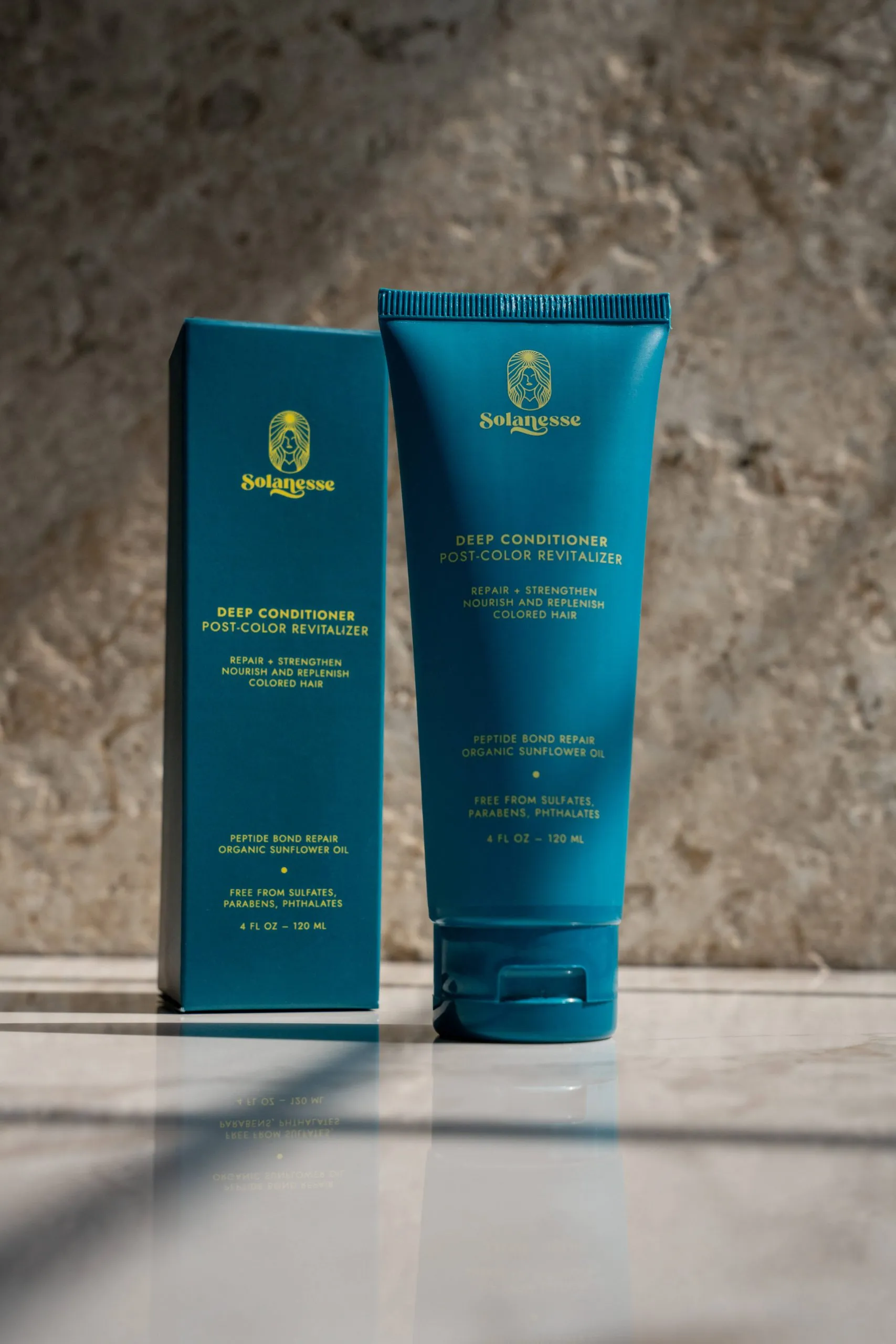
Solanesse Post-Color Revitalizer is positioned as a single-step deep conditioning treatment for hair affected by coloring, bleaching, heat, and other chemical services. It is designed to support the broader hair structure and improve softness, smoothness, and manageability. It should complement regular trims, not be presented as a way to fuse a split end permanently.
Care for the whole fiber
The brand’s clean clinical position focuses on more than a surface coating. Solanesse describes support for the cuticle, cortex, and cell membrane complex, with ingredients such as hydrolyzed keratin, collagen, peptides, and sunflower oil. These claims describe the product’s intended positioning. They do not change the physical limit that an established split still needs to be trimmed.
Used with gentler handling, a treatment can help processed hair feel more supple and manageable. That can make it easier to detangle without unnecessary pulling and easier to maintain between color services. If the ends remain visibly forked, schedule the trim first and use the treatment as ongoing support.
Keep the format simple
The Post-Color Revitalizer is designed as a 10 to 15 minute rinse-out step. Apply it to warm, damp hair after cleansing, work it through the lengths and ends, leave it on for the stated time, and rinse thoroughly. Follow the product directions and adjust frequency based on how your hair responds.
A simple format can make regular care easier to maintain. For a closer look at the product’s directions and ingredients, visit the Solanesse Post-Color Revitalizer product page. Pair the routine with professional advice when damage is extensive or the scalp is uncomfortable.
Choose a clean, measured approach
Solanesse is formulated without sulfates, parabens, silicones, and phthalates, according to its product positioning. A clean formula can align with your preferences, but exclusions are not a substitute for realistic hair-care habits. Use the treatment to support softness and manageability, inspect the ends regularly, and trim established splits rather than expecting a cosmetic product to erase them.

Build a consistent post-color conditioning ritual with Solanesse
Frequently Asked Questions
Can a split end repair treatment permanently fix split ends?
No. It can condition, smooth, and temporarily reduce the visible look of a split. A physically separated fiber remains separated. A trim is the lasting way to remove that damaged portion.
Do split end treatments work for color-treated hair?
They can improve softness, slip, and manageability in color-treated hair. Those benefits may reduce friction and help limit additional breakage. They should support, not replace, gentler handling and trims when the ends are physically split.
What ingredients should I look for?
Look for conditioning agents, proteins or peptides, and lightweight oils that match your hair’s needs. The formula should leave the ends manageable without excessive stiffness or weight. Ingredient choice cannot change the permanent repair limit for an established split.
How often should I use a deep treatment?
Follow the product directions and adjust based on how your hair feels. Many people use a richer treatment weekly or after a color service. More product is not always better. Focus on consistent conditioning and gentle handling.
When should I get a haircut for split ends?
Book a trim when splits travel upward, ends keep catching or snapping, or roughness returns soon after conditioning. Ask for a measured cut that removes the damaged portion while respecting your length goal.
Get Started With a Considered Post-Color Ritual
A split end repair treatment is most useful when its role is clear: condition the hair you want to keep, reduce friction, and support a consistent post-color routine. When a tip has truly separated, pair that care with a professional trim. Explore Solanesse’s Post-Color Revitalizer to add a focused deep-conditioning step to your wash day.


