


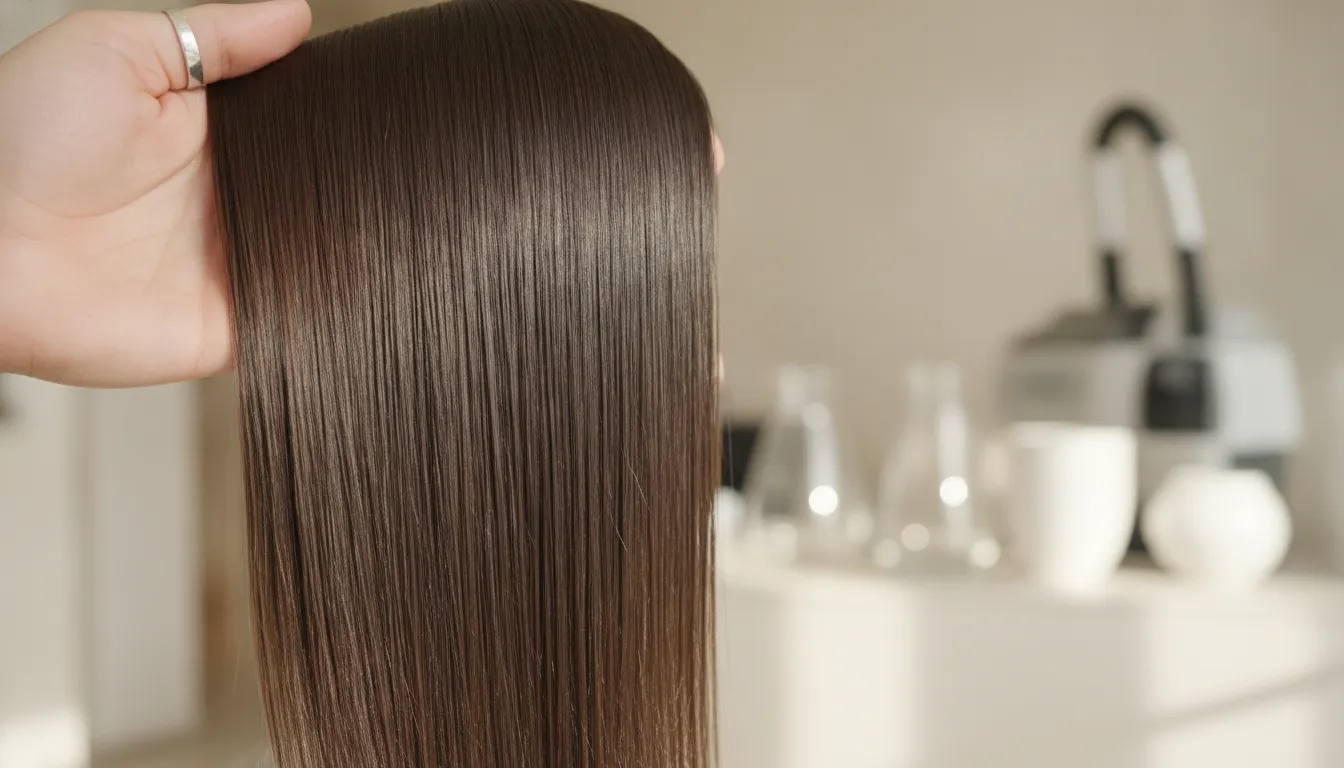
Coloring every six to eight weeks can leave hair feeling rough, porous, and increasingly difficult to manage, even when the shade still looks beautiful. That is why smoothing treatments can seem appealing: they promise less frizz, more shine, and a softer finish without asking you to change your color routine.
A keratin treatment for damaged hair can temporarily coat the strand with a protein layer that reduces frizz and improves manageability. But it does not necessarily repair damage beneath the surface. Keratin is a structural protein naturally found in hair, while true repair must also address the cuticle, cortex, and cell membrane complex. Color-treated hair may be suitable for treatment, although porosity, heat, chemicals, and moisture-protein balance all affect the result.
The distinction matters when your goal is more than a polished finish. A treatment that smooths the outer surface may help hair feel healthier for a time, yet highly processed strands still need careful support at the structural level. Before deciding whether smoothing is appropriate, it helps to understand what keratin treatments actually do to damaged hair and where their benefits end.
Support damaged, color-treated strands at home with the Deep Conditioner Post-Color Revitalizer.
What a Keratin Treatment Does for Damaged Hair
Keratin is a structural protein naturally found in hair. It contributes to the strength and elasticity that help a healthy strand withstand brushing, styling, and daily friction. Because chemical color, bleach, heat, and environmental exposure can weaken that structure, keratin is often presented as a natural choice for damaged hair. The important distinction is what the treatment does to the strand, and what it can realistically repair.
Keratin can improve the surface of the hair
Most salon smoothing treatments apply a keratin-containing formula to the hair, then use heat to help create a smoother, more uniform surface. The resulting protein layer can fill or cover irregularities along the strand, helping reduce frizz and making hair feel softer and easier to style. It may also increase the appearance of shine because a smoother surface reflects light more evenly.
That cosmetic effect can be useful, especially when damaged hair feels rough or behaves unpredictably. It is not the same as rebuilding the internal structure of the hair. Research describing keratin-based hair treatments distinguishes between surface coating and deeper repair of damaged components. A conventional smoothing service is therefore best understood as a temporary way to improve manageability, rather than a complete answer to structural damage. Read the research on keratin-based hair protection and restoration.
Where damage begins matters
The cuticle is the outermost layer of the hair shaft and one of the most common sites of visible damage. When its overlapping scales become lifted, worn, or uneven, hair can lose smoothness and reflectivity. It may also tangle more easily and feel less conditioned. A coating can temporarily make this surface feel more polished, but it does not automatically restore every layer affected by chemical processing.
For a damaged strand, the cortex and cell membrane complex also matter. These internal structures contribute to the hair’s strength, flexibility, and cohesion. A formula focused only on external smoothing may make hair look healthier without fully addressing those deeper losses. This is why the label “keratin treatment for damaged hair” can describe very different approaches. From a salon service designed primarily to control frizz to a treatment engineered to support damaged structure.
Not all keratin technologies work the same way
Keratin-based particles can be engineered with the goal of protecting and restoring hair structure, rather than simply forming a surface film. That distinction depends on the formula, particle design, delivery system, and condition of the hair. In practical terms, look beyond the word keratin and ask whether the product is intended to smooth the surface, condition the strand, or address multiple structural layers.
A smoothing treatment can be appropriate when your priority is reduced frizz and faster styling. If your hair is breaking, highly porous, or repeatedly processed. It may need a broader repair routine that balances surface conditioning with support for the cuticle, cortex, and cell membrane complex.
The Real Benefits of a Keratin Treatment for Damaged Hair
When damaged hair feels rough, expands in humidity, or tangles during styling, a keratin smoothing service can make it feel significantly easier to manage. The visible benefit comes from creating a more uniform surface around the strand. Hair can look smoother, reflect more light, and require less brushing and heat to achieve a polished finish.
Less frizz and easier styling
Most smoothing keratin treatments deposit a protein layer over the hair. That coating helps reduce the friction and unevenness that contribute to frizz, so the hair may dry more smoothly and respond better to a brush or blow-dryer. The practical result is manageability: fewer tangles, less time spent controlling the shape, and a softer-looking finish.
This can be especially useful when chemical processing has lifted the cuticle and left the surface porous. However, the improvement is primarily cosmetic and functional. A smoother surface does not automatically mean that weakened internal structures have been restored.
Temporary smoothing and protection
Results commonly last about two to four months, depending on the formula, washing routine, heat exposure, and condition of the hair. As the coating wears away and new growth appears, frizz and porosity can gradually return. That timeframe makes keratin smoothing a temporary management tool rather than a permanent solution for damage.
Keratin treatments can also be applied to color-treated hair. Porous, color-processed strands may not hold the smoothing effect as long as healthier hair. And the heat or chemicals used in some services may slightly alter or dull toner. A stylist should assess the hair’s porosity and color history before treatment, particularly when the hair has also been lightened.
What the research suggests about photo-damaged hair
There is a distinction between a conventional smoothing service and a formula engineered to do more than sit on the surface. Research on keratin-encapsulated cationic liposomes has examined their role in the recovery and protection of photo-damaged hair, suggesting that delivery system and formulation matter. The published study is relevant to protection research, but it should not be treated as proof that every salon keratin treatment repairs damaged hair.
The most honest way to view the benefit is simple: keratin smoothing can reduce frizz, improve manageability, and provide temporary surface protection. It does not by itself rebuild every damaged component of the hair shaft. If the strand is breaking, stretching when wet, or losing density after repeated color services. Pair any smoothing decision with a plan for moisture, gentle handling, and genuine structural care.
Keratin Treatment Risks Worth Weighing Before You Book
Keratin smoothing can make difficult hair easier to manage, but a smoother surface is not the same as restored hair. Before booking, consider how the formula, heat, frequency, and your existing damage may affect the result. A treatment can be reasonable for one head of hair and too aggressive for another, especially when strands are already porous from bleaching or repeated color services.
| Potential benefit | Risk or trade-off to consider |
|---|---|
| Less frizz and easier styling | The effect is temporary and may fade as the coating wears away and new growth appears. |
| A smoother, more polished appearance | Most smoothing formulas coat the hair with a protein layer rather than repairing damage below the surface. |
| Results that can last for several weeks | Treatments can be costly and may require touch-ups every two to three months. |
| Convenient salon-based smoothing | Some formulas contain formaldehyde or release it when heated, creating a potential eye and respiratory irritation concern. |
| Added protein and temporary body | Repeated protein exposure without enough moisture can contribute to protein overload and brittle hair. |
Pay attention to the formula and the salon environment
Formaldehyde is the most important safety question to raise during a consultation. The CDC’s National Institute for Occupational Safety and Health documented formaldehyde exposure during a salon hair-smoothing treatment. Exposure can irritate the eyes and respiratory tract, and fumes may become more noticeable when the product is heated. Ask for the complete ingredient information, whether the formula contains formaldehyde or a releasing agent, and what ventilation and protective measures the salon uses. A label described as “formaldehyde-free” also deserves clarification about the ingredients used during heat activation.
Protein needs moisture to stay useful
Keratin is a structural protein, so adding protein may sound like an obvious choice for fragile hair. The balance matters more than the label, however. Overuse of keratin or other protein-rich products can leave strands stiff, dry, and brittle when the routine does not restore enough moisture. If your hair begins to feel rough rather than supple, snaps more easily, or resists conditioning, pause additional protein treatments and reassess with a stylist. Treat smoothing as a cosmetic service with maintenance demands, not as a permanent repair for the hair shaft.
The most informed decision weighs the desired manageability against your hair’s current condition, the product’s safety profile, and your willingness to maintain the result. If the primary problem is severe dryness or breakage, address moisture and structural support before adding another chemical or heat-intensive service.
Is a Keratin Treatment Right for Color-Treated Hair?
Yes, a keratin smoothing treatment can be performed on color-treated hair, but the condition and porosity of the strands should guide the decision. Hair that has been colored, highlighted, or bleached may have a more open, porous cuticle. That porosity can allow the treatment to absorb unevenly and can make the smoothing effect less durable than it is on less-processed hair. The result may still be smoother, more manageable hair, but it should not be mistaken for permanent repair.
Timing also matters. Applying a smoothing service immediately after a major color change can place additional chemical and heat stress on already-compromised strands. A stylist should assess elasticity, dryness, breakage, and the condition of the ends before recommending the service. If hair stretches excessively when wet, snaps easily, or feels rough from root to tip, improving its moisture balance first may be the more protective choice.
How can keratin affect color and toner?
Some keratin treatments may slightly alter or dull toner because the process combines heat with chemicals. This is especially relevant for cool blondes, glossed brunettes, and other shades that rely on a precise toner for their final tone. The effect is not identical with every formula, so ask the salon which product will be used. Whether it contains formaldehyde or releases it when heated, and how the service may interact with your color. The CDC has documented eye and respiratory irritation concerns related to formaldehyde exposure during salon hair-smoothing treatments, making ventilation and product transparency important safety considerations: review the CDC safety report.
If preserving tone is your priority, discuss whether color and smoothing should be separated rather than scheduled together. Your stylist may recommend completing one service first, allowing the hair and scalp to settle, then reassessing the color before the second. There is no universal interval that suits every head of hair, because formula strength, processing history, and strand condition all change the risk profile.
Aftercare for treated, porous strands
Use a gentle, moisture-supporting routine after the service. Limit unnecessary heat, protect the hair during styling, and avoid stacking frequent protein-heavy products without balancing them with hydration. Excessive protein can leave some hair brittle, particularly when moisture is neglected. For a broader routine focused on maintaining softness and vibrancy, see our guide to care for color-treated hair.
Ultimately, keratin smoothing may be reasonable when the goal is temporary frizz control and easier styling. If the primary concern is bleach-related weakness or breakage, prioritize care that supports the hair’s underlying structure rather than relying on a surface coating alone.
How to Choose a Keratin Treatment for Damaged Hair
The best keratin treatment for damaged hair depends on what you want the formula to do. If your priority is smoother styling, less frizz, and a polished surface, a coating formula may be appropriate. If your hair feels porous, weak, rough, or prone to snapping after color or chemical processing. Look for evidence that the treatment addresses the hair structure rather than simply making it feel smoother.
Start by separating smoothing from structural repair
Most smoothing keratin treatments deposit a protein layer over the hair. That coating can reduce friction and frizz, which may make the strands easier to manage. It does not necessarily rebuild damage beneath the surface. Research distinguishes this temporary coating effect from structural repair that targets the cuticle, cortex, and cell membrane complex, the interfaces that help preserve the hair shaft’s integrity. The published research on keratin-based hair treatments provides useful context for making that distinction.
Read the product claims closely. Words such as “smooth,” “straighten,” and “seal” usually describe a surface result. They are not proof that a formula can restore compromised internal structures. A more credible repair claim should explain what type of damage it addresses, which ingredients support that function, and how the result is evaluated. Be cautious when a treatment promises permanent restoration from one application.
Look for a repair mechanism, not just a keratin label
Keratin is relevant because it is a structural protein naturally found in hair. However, the presence of keratin on an ingredient list does not tell you whether it will form a temporary film or contribute to a more considered repair system. One area of research involves enzymatic crosslinking of amino acids. In a study of chemically damaged hair, this approach improved repair. Suggesting that the way a formula reinforces damaged fibers may matter as much as the protein it contains. Read the research on enzymatic crosslinking and chemically damaged hair for the technical background.
If hair has been affected by bleach, relaxers, or repeated chemical straightening, prioritize a treatment plan that respects the full fiber. Chemical straighteners can affect hair-shaft integrity, so a glossy finish alone should not be treated as proof of recovery.
Check safety and your hair’s condition
For salon smoothing, ask for the complete ingredient and safety information before booking. Choose a formaldehyde-free formula, and ask whether any ingredient can release formaldehyde when heated. Formaldehyde exposure during hair-smoothing applications has been associated with eye and respiratory irritation, according to CDC and NIOSH salon-safety guidance.
Finally, match the treatment to the strand’s condition. Highly porous or chemically damaged hair may need moisture and structural support before additional heat or smoothing chemistry. A treatment that improves manageability without addressing the cause of brittleness may look successful while leaving the underlying weakness unchanged.
How to Protect Damaged Hair Before, During, and After
Damaged hair needs a controlled routine around any smoothing service. Keratin can improve surface feel, but it should not replace moisture management, sensible heat use, or attention to the condition of the hair shaft. The goal is to reduce additional stress while supporting a workable balance of protein and moisture.
-
Prepare with moisture and targeted repair
Before your appointment, assess whether your hair feels dry, rough, stretchy, or brittle. Severely damaged hair is generally better served by rebuilding moisture and protein balance than by adding another smoothing-only layer. Deep conditioning masks and bond-repair formulas can support the cuticle and cortex while you reduce further chemical stress. Read this guide to repair damaged hair at home for a practical baseline routine.
Do not assume that more protein is always better. Keratin and other protein-based products can leave hair brittle when overused without enough moisture. Alternate strengthening care with hydration, and adjust the frequency based on how your hair responds. Softer, more flexible strands are a better starting point than hair that feels stiff or straw-like.
-
Reduce heat and choose the formula carefully
Discuss your hair history with the stylist, including bleach, permanent color, previous straightening, and recent breakage. Reduce heat styling before and after the service whenever possible. High heat can compound dryness and mechanical weakness, especially in porous strands. Use the lowest effective temperature, apply heat protection, and avoid repeated passes over the same area.
Ask exactly what the formula contains and how it is activated. Some smoothing products contain formaldehyde or release it when heated, which can irritate the eyes and respiratory tract. The CDC has documented formaldehyde exposure as a salon safety concern. Review the CDC salon exposure report, and ask for a formaldehyde-free option when appropriate. A clear ingredient and ventilation discussion is part of responsible treatment selection.
-
Maintain a gentle washing routine
After the treatment, follow the stylist’s specific washing instructions rather than adding unnecessary products. When you wash, use a gentle, moisture-stabilizing routine that supports both the smoothing result and your color. Avoid aggressive scrubbing, very hot water, and frequent clarifying unless a professional recommends it. These habits can strip surface conditioning and leave porous hair feeling rough again.
-
Continue deep conditioning and monitor the balance
Keep deep conditioning in your regular schedule, especially after color or other chemical processing. A consistent mask can help restore hydration between washes, while occasional repair-focused care supports strength. This deep conditioning guide explains how to make that step more effective.
Finally, monitor texture instead of chasing a fixed schedule. If hair becomes stiff, brittle, or increasingly difficult to detangle, pause additional protein-heavy treatments and prioritize moisture. If it remains weak or breaks despite gentler care, seek an in-person assessment before repeating a smoothing service.
When Damaged Hair Needs More Than a Smoothing Treatment
A smoothing treatment can make damaged hair feel softer, look shinier, and behave more predictably. That visible improvement matters, especially after repeated color, bleach, or heat styling. It does not always mean the hair’s underlying structure has recovered. Most smoothing keratin treatments form a protein layer over the strand to reduce frizz. They can temporarily improve the surface without repairing damage within the cuticle, cortex, or cell membrane complex, the intercellular layer that helps hold the hair’s structure together. Keratin smoothing is not the same as structural repair.
Look beyond the surface
The cuticle is the hair shaft’s outermost layer and one of the first areas affected by chemical processing. When it becomes lifted or irregular, the strand loses smoothness and becomes more porous. The cortex beneath it contributes much of the hair’s strength and elasticity. Between these regions, the cell membrane complex supports cohesion and movement of moisture through the fiber. If these areas remain compromised, a coating may improve the feel of the hair while the strand is still vulnerable to snapping, roughness, and uneven moisture absorption.
This distinction is especially important when damage comes from more than color alone. Chemical straighteners can affect hair shaft integrity, adding another source of structural stress to an already porous fiber. Repeated processing may leave hair that feels stiff in some areas, overly elastic when wet, or fragile at the ends. In that situation, choosing a keratin treatment for damaged hair based only on smoothness can miss the actual need: support for the internal architecture of the strand.
A structural repair approach at home
Structural-focused care is designed to address more than the surface. Research on hair restoration identifies the cell membrane complex as a target when the goal is to improve the integrity of damaged hair, rather than simply cover it. That does not make a home conditioner equivalent to a salon chemical service, and no treatment can reverse every form of irreversible loss. It does create a more appropriate maintenance strategy for hair that needs ongoing support between color appointments.
Solanesse’s Deep Conditioner Post-Color Revitalizer is formulated for this post-color repair ritual. Its structural repair system combines Hydrolyzed Keratin, Collagen, and Peptides to support the cuticle, cortex, and cell membrane complex. The formula is intended for at-home maintenance after coloring, bleaching, and other chemical processing, not as a replacement for professional evaluation when hair is severely compromised. Apply it to warm, damp hair for 10 to 15 minutes, then rinse. Use it weekly or as needed, adjusting frequency to your hair’s response.
For a closer look at the ingredients and the science behind this approach, visit Science & Ingredients. The practical question is not whether smoothing has value. It is whether your routine also supports the damaged structures that smoothing alone cannot reach.
Give color-treated hair the targeted hydration it needs with the Deep Conditioner Post-Color Revitalizer.
Frequently Asked Questions
Are keratin treatments good for damaged hair?
They can be useful when your main concern is frizz, rough texture, or difficult styling. Most smoothing treatments place a protein layer over the strand, which can make damaged hair feel smoother and look shinier for a time. That surface effect is different from repairing the cuticle, cortex, and cell membrane complex beneath it. If color or bleach has left your hair porous, weak, or prone to snapping, pair any smoothing service with a moisture and protein-balanced repair routine. A keratin treatment can improve manageability, but it should not be your only response to significant structural damage.
Does keratin repair or just coat the hair?
Most salon smoothing keratin treatments primarily coat the hair rather than rebuilding its internal structure. The coating can reduce friction and frizz, so the result may feel like stronger hair even when the underlying damage remains. True structural repair targets damaged areas within the cuticle, cortex, and cell membrane complex. Read the formula and ask your stylist what the treatment is designed to do: smooth the surface, restore strength, straighten the hair, or provide conditioning. That distinction helps you choose a service that matches your hair’s actual condition.
Is a keratin treatment safe for color-treated or bleached hair?
It can be performed on color-treated hair, but the decision depends on porosity, elasticity, and the specific formula. Colored or bleached strands may hold the smoothing effect for less time because their surface is more porous. Heat and chemical processing can also alter or dull a toner. Ask your stylist to assess a small section first, especially if your hair feels stretchy when wet, breaks during brushing, or has recently been lightened. A gentle, moisture-stabilizing routine can help support both the color and the treated hair between appointments.
What are the main risks of a keratin treatment?
The risks vary by product and technique. Some smoothing formulas contain formaldehyde or release it when heated, and exposure can irritate the eyes and respiratory tract, according to a CDC and NIOSH salon safety report: CDC and NIOSH report. Ask for the complete ingredient and safety information, and choose a well-ventilated salon. Repeated protein-heavy services can also leave hair brittle when moisture is neglected. Discuss your chemical history, current breakage, and maintenance expectations before booking.
How long does a keratin treatment last?
The smoothing effect commonly lasts about two to four months, depending on the formula, your hair’s porosity, washing routine, and new growth. It fades as the coating wears away, so frizz and roughness can gradually return. A longer-lasting cosmetic result does not necessarily mean the strand has been repaired. Use gentle cleansing, limit unnecessary heat and chemical processing, and maintain a balanced conditioning routine. If your hair remains fragile after the surface effect fades, reassess whether smoothing is addressing the problem you actually want to solve.
What is better for severely damaged hair than a smoothing-only treatment?
Start by reducing the sources of damage, particularly repeated high heat, overlapping chemical services, and aggressive detangling. Then focus on restoring moisture and maintaining an appropriate balance between conditioning and protein. Deep conditioning and repair formulas can support the cuticle and cortex while the hair grows out. Severely compromised ends may need trimming because a product cannot permanently reconnect every split or prevent a weakened section from breaking. If your hair is gummy, snapping, or shedding unusually, pause chemical services and ask a qualified stylist or clinician for an assessment.
Ready to Support Hair After Color or Keratin Smoothing?
If your hair feels dry, porous, or less resilient after color, bleach, or a smoothing service. A focused at-home repair ritual can help you maintain a healthier feel between appointments. Solanesse’s Deep Conditioner Post-Color Revitalizer is designed for the structural needs of processed hair. With a treatment approach that supports the cuticle, cortex, and cell membrane complex rather than focusing only on surface smoothness. Apply it as part of a consistent post-color routine, then adjust frequency to your hair’s condition. To explore the treatment and see whether it fits your routine, explore the Deep Conditioner Post-Color Revitalizer.


