


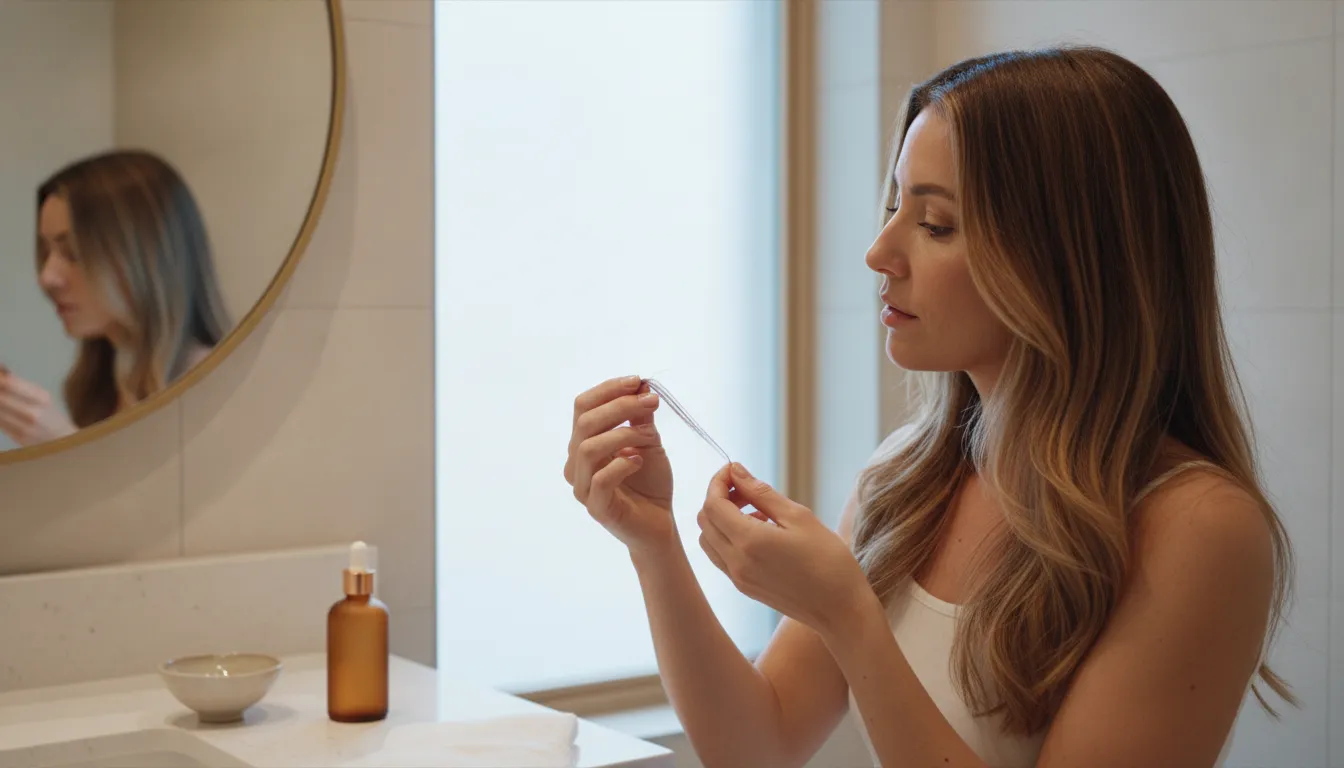
Hair can feel different after color, bleach, heat, or straightening, but a quick home check should be treated as an observation, not a verdict. The goal is to notice changes gently and consistently, without pulling hard enough to create new breakage.
Shop the Solanesse Deep Conditioner – Post Color Revitalizer for a considered post-color care step.
To learn how to test hair elasticity, use one clean, damp strand from an inconspicuous area and apply only light tension. Notice whether it stretches slightly, feels unusually gummy, breaks, or shows little recovery. Stop immediately if the strand feels fragile or behaves unexpectedly. This check cannot diagnose damage or prove that hair is ready for another chemical service.
Elasticity is one visible part of how the hair fiber behaves. Understanding what that behavior may reflect, and where a home observation stops being useful, makes the next steps more measured.
What Does Hair Elasticity Tell You?
Hair elasticity is the fiber’s observable ability to stretch slightly and move back toward its original shape. A simple home check can help you notice how a strand behaves, especially when comparing hair before and after a color service. It is an observation, not a validated diagnosis or a guarantee that hair is ready for more chemical processing.
Elasticity is not the same as strength or shine
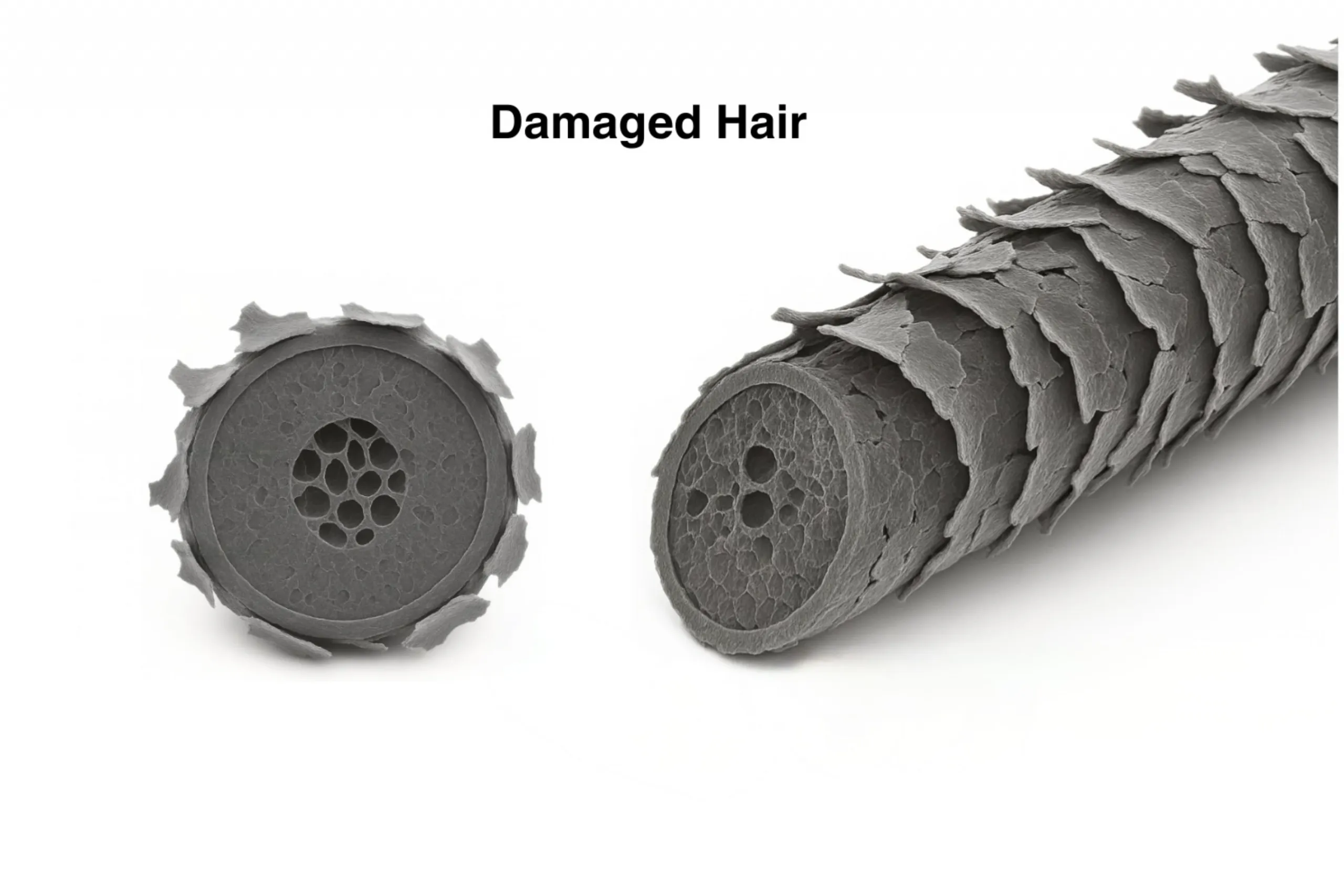
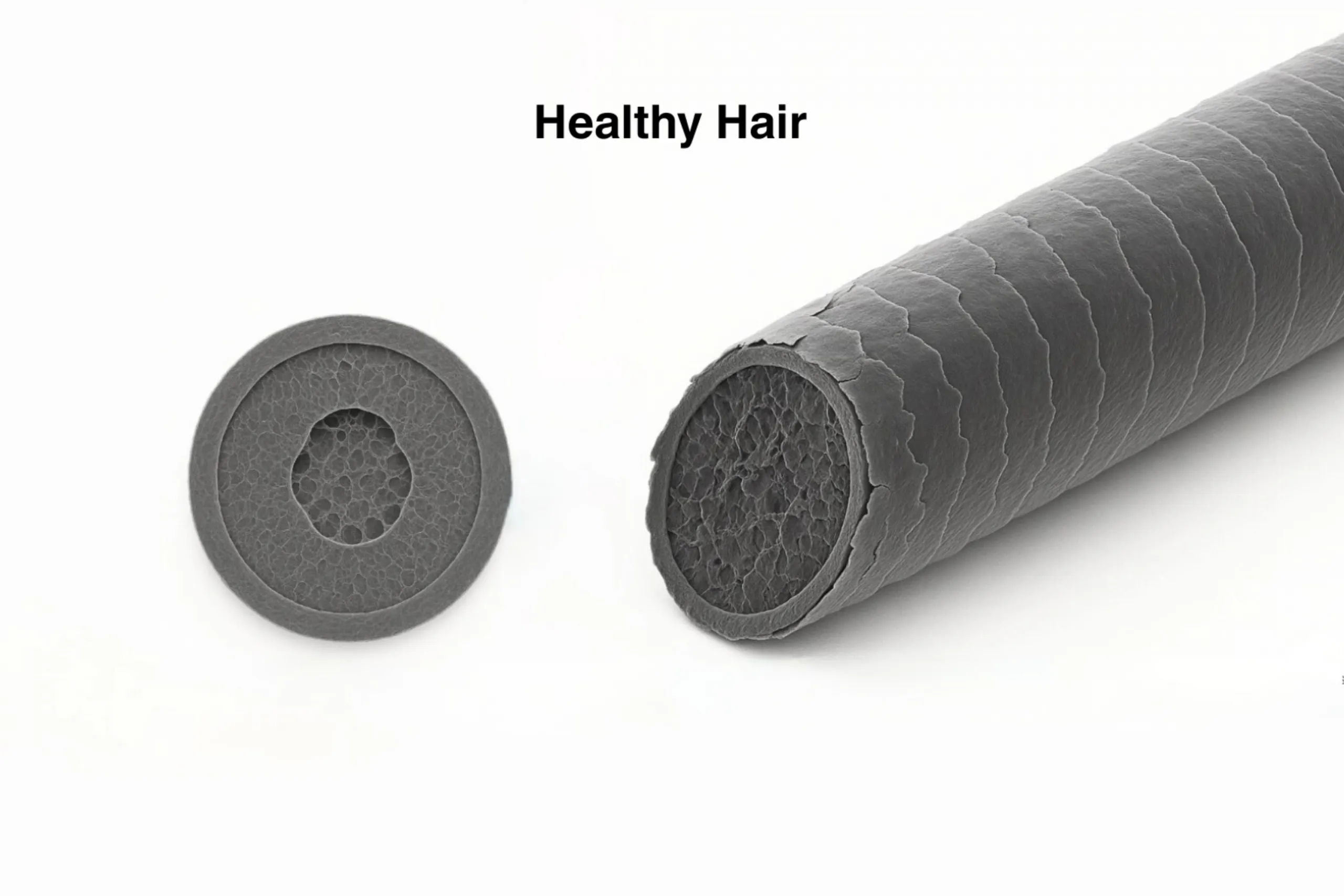
The cortex makes up most of the hair fiber and contains keratin and keratin-associated proteins that provide much of its mechanical strength. That cortex is enclosed by a protective cuticle layer. In Solanesse’s hair-structure guidance, the cortex is associated with strength and elasticity, while the cuticle is associated with surface shine and smoothness. A strand may look glossy without answering how it responds to stretch, and a strand that feels strong is not automatically elastic.
For a broader explanation of these distinctions, see this guide to hair strength and elasticity.
Why the home check has limits
Laboratory tensile testing measures defined properties under controlled conditions, such as modulus, break extension, and break stress. Research comparing wet and dry testing found that these measures can respond differently to chemical treatment and testing state. So a wet observation cannot simply stand in for a dry laboratory result. Read the research on wet and dry hair tensile testing for that technical context.
Use the home check to observe unusual behavior without forcing the strand. It cannot identify the cause of a change, measure structural damage, or clear hair for a chemical service. If hair feels gummy, breaks, or behaves unusually, stop rather than stretching further.
How to Test Hair Elasticity at Home Without Overstretching
A gentle check can help you notice how a small section of hair behaves. But it cannot diagnose structural damage or confirm that your hair is ready for another chemical service. Treat the result as one observation, not a pass or fail test.
- Prepare clean hair and hands. Wash away heavy styling residue, then work with clean, dry hands. Choose a calm moment when you can observe the strand without rushing. If you are comparing results over time, keep the basic conditions as consistent as possible.
- Select one small strand. Choose a discreet strand from an area that reflects the hair you are concerned about. Do not gather a large section or test repeatedly. A single strand gives you a limited snapshot, not a complete picture of the hair fiber.
- Observe before pulling. Look and feel without applying tension. Notice whether the strand appears unusually rough, fragile, or inconsistent with nearby hair. If it already seems compromised, stop rather than testing further. For broader context on care choices, see this guide to protein and moisture treatments.
- Apply only a light stretch. Hold the strand gently and introduce minimal tension, just enough to observe its response. Never tug, snap, twist, or try to make the strand reach a particular distance. The goal is to avoid creating the damage you are trying to understand.
- Watch the recovery. Release the strand and notice whether it returns toward its previous shape or behaves in an unusual way. Stop immediately if it feels gummy, stretches without control, or breaks. Those signs call for gentler handling, not a stronger test.
- Record the conditions. Note whether the hair was freshly washed, dry or damp, recently colored, heat styled, or otherwise treated. Write down what you observed without assigning a diagnosis. Conditioner can coat strands and reduce breakage, so post-wash feel may not represent every aspect of the fiber. Professional assessment is appropriate for persistent concerns or before further chemical processing.
Conditioning and gentle handling support a lower-trauma routine, but this home observation does not replace validated tensile testing or a qualified stylist’s assessment.
How Should Healthy-Looking Stretch and Recovery Be Interpreted?
Use the home check as a qualitative observation, not a pass-or-fail result. A strand that stretches and returns quickly may feel reassuring, while a strand that stretches excessively, feels gummy, or breaks deserves caution. None of these observations can identify the cause of a change or confirm that hair is ready for another chemical service.
| Observation | Cautious interpretation | What it does not prove |
|---|---|---|
| Quick recovery | The strand appears to return toward its original shape after light tension. | It does not prove that the fiber is undamaged or ready for processing. |
| Excessive stretch | The strand may be behaving unusually and should be handled gently. | It does not identify a specific type or degree of damage. |
| Little stretch | The strand feels relatively resistant during a very light observation. | It does not establish strength, flexibility, or chemical safety. |
| Gummy feel | Stop the check and avoid adding tension or processing. | It is not a diagnosis. |
| Breakage | Stop immediately and consider qualified professional guidance. | It does not reveal the underlying cause on its own. |
Laboratory tensile testing measures properties such as modulus, break extension, and break stress. Research shows that these parameters can respond differently to chemical or thermal treatment and to wet versus dry testing conditions. A home observation measures none of them, and it is not equivalent to laboratory testing. For the technical distinction between these measures, see the published tensile-testing study. Treat your notes as a reason to handle hair carefully or seek advice, not as a clearance for your next service.
How to Compare Hair Elasticity Before and After Chemical Processing
A before-and-after check is useful only when the conditions are as similar as possible. Choose the same general area of hair, such as the mid-lengths on one side, and use strands with a similar processing history. Do not compare an untreated root with previously bleached ends. Existing damage can change how the fiber responds, so a difference may reflect the starting condition rather than the latest service.
Record what happened before you test: coloring, bleaching, straightening, a chemical service, or repeated heat styling. Keep the timing consistent as well. If the first observation was made after washing, compare it after a similar wash and drying routine. Note whether the strand is wet or dry, because those states do not produce interchangeable mechanical results. Research on tensile testing found that chemical and thermal treatments, as well as wet-versus-dry conditions, can affect different hair-fiber measures in different ways. Read the study on wet and dry hair testing for the laboratory context.
Use the same gentle, limited observation each time. Notice whether the strand stretches slightly, feels unusually soft or gummy, returns toward its original shape, or breaks. Avoid pulling harder to make the second result seem more conclusive. This is a qualitative comparison, not proof that a service was safe or that hair is ready for another chemical process.
Repeated bleaching, dyeing, and straightening may create subtle shaft changes that are not obvious during a basic visual check. One study found that specialized scanning electron microscopy detected differences that routine examination and light microscopy did not. Treat a concerning change as a reason to pause and ask a qualified stylist for an assessment, not as a diagnosis. For practical next steps, see our guide to at-home care for color-damaged hair.
What Should You Do If Hair Feels Gummy or Breaks?
If a strand feels gummy, stretches without seeming to recover, snaps during a gentle check, or behaves differently from the rest of your hair, stop testing. Do not pull again to confirm the result. A home elasticity check is a limited observation, not a diagnosis, and it cannot clear your hair for another chemical service.
Pause coloring, bleaching, relaxing, perming, or other chemical processing until the hair has been assessed. Handle it as gently as possible: detangle slowly with minimal tension, avoid vigorous brushing or rubbing, and wash and condition without aggressive manipulation. The American Academy of Dermatology recommends gentle washing and conditioning for fragile hair. A moisturizing conditioner can coat the strands and help reduce breakage and split ends, but conditioning should not be presented as permanent repair of structural damage. Read the AAD guidance on managing fragile hair.
Keep heat low or avoid hot tools while the hair is behaving unusually. Do not use a second product or chemical treatment as an improvised test. Note what happened, including whether the hair was wet or dry, which area you checked, and any recent color, bleach, heat, or straightening service. These details can help a professional evaluate the situation.
For persistent gummy texture, repeated breakage, noticeable shedding, scalp discomfort, or concern before further processing, contact a qualified stylist who can examine the hair in person. If the concern involves the scalp, hair loss, or a change that does not resolve, a dermatologist is the appropriate clinician for assessment. You can also review Solanesse’s explanation of hair structure, elasticity, and post-color care for context, not a diagnosis.
When Should You Stop Coloring, Bleaching, or Heat Styling?
Pause the service if your hair starts behaving differently during preparation or styling. Stop when strands feel unusually soft and gummy, snap with gentle handling, tangle suddenly, or show a sharp change from the surrounding hair. Also stop if your scalp becomes painful, intensely irritated, or feels chemically burned. Do not continue simply because the planned color, bleach, straightening, or relaxer has not reached its intended result.
A home elasticity observation can help you notice a change, but it cannot clear your hair for another chemical service. A strand may feel acceptable in one condition and respond differently when wet, dry, stretched, heated, or exposed to a formula. Hair behavior reflects several interacting forces, including chemical, mechanical, and thermal stress. These stresses can affect hydrogen and disulfide bonds, and the bond response is not uniform throughout every fiber. Research describes hair’s chemical-bond behavior as complex rather than homogeneous.
For chemical coloring, bleaching, perming, relaxing, or straightening, postpone the service and ask a qualified stylist to examine your hair and scalp. The American Academy of Dermatology also advises stopping at-home coloring, perming, chemical straightening, and relaxing when hair loss is present, and limiting hot tools because heat can weaken hair: AAD hair-care guidance. If you use heat later, keep it occasional and gentle. For a related care approach, see keratin care for color-treated hair, without treating it as permission to resume processing.
How Can You Care for Hair After an Elasticity Check?
Once you have finished the observation, leave the strand alone. Do not repeat the stretch several times or pull harder to obtain a clearer result. A home check can highlight unusual behavior, but it cannot diagnose structural damage or confirm that hair is ready for another chemical service.
Handle wet hair gently. Use your fingers or a wide-tooth comb to detangle from the ends upward, and avoid rough towel rubbing. The American Academy of Dermatology recommends conditioning after shampooing because conditioner coats the strands and can reduce breakage and split ends. If you are deciding between protein and moisture treatments, consider the broader feel and history of your hair rather than treating one quick observation as a diagnosis.
Keep hot-tool exposure modest while you monitor how your hair behaves. Curling irons, flat irons, and hot combs can weaken hair, so air-drying or using lower heat with careful handling may be the gentler choice. Record what you noticed, including whether the strand felt unusually soft, gummy, rough, or fragile, and note recent coloring, bleaching, straightening, or heat use. Consistent notes are more useful than repeated testing under changing conditions.
Solanesse describes elasticity in relation to the cortex, while the cuticle contributes to surface smoothness and shine. That distinction supports a measured care routine, not a promise of permanent repair. For persistent concerns, visible breakage, or plans for further chemical processing, speak with a qualified stylist. The product is intended for post-color conditioning, not professional assessment.
For a restrained post-color care step, explore the at-home post-color conditioning treatment.
Frequently Asked Questions
How do you test hair elasticity at home?
Start with a clean, damp strand and handle it gently. Apply only light tension, then observe whether the strand stretches slightly and returns toward its original shape. Stop immediately if it feels gummy, breaks, or behaves unusually. This is a limited observation, not a validated diagnosis or a guarantee that your hair is ready for chemical processing.
Should you test hair elasticity when it is wet or dry?
Use the same hair state each time you compare results, and record whether the strand was wet or dry. Wet and dry tensile measurements can produce different responses, so a home observation in one state should not be treated as interchangeable with the other. Laboratory research evaluates separate tensile properties under controlled conditions, not a simple at-home stretch check (PMC9544838).
What should you do if hair feels gummy during a stretch test?
Stop the test and postpone further coloring, bleaching, straightening, or heat styling. Handle the hair gently, cleanse without rough friction, and condition it rather than repeating the check. Ask a qualified stylist to assess persistent concerns or the hair’s suitability for another chemical service. If you also have significant hair loss or a scalp concern, a dermatologist can evaluate conditions affecting hair and skin, as advised by the American Academy of Dermatology (AAD).
Does an elasticity test prove that hair is ready for chemical processing?
No. A strand may look or feel different because of moisture, prior damage, chemical history, or handling, and a home check cannot measure every factor that affects fiber behavior. Treat the result as one cautious observation, not clearance for a service. When in doubt, pause and seek a professional assessment before processing.
Get Started With a Considered Post-Color Ritual
Use conditioning after an at-home observation, but do not treat the check as a diagnosis or guarantee of repair. Pause chemical services if hair feels fragile. Shop the Solanesse Deep Conditioner – Post Color Revitalizer for post-color conditioning.


