


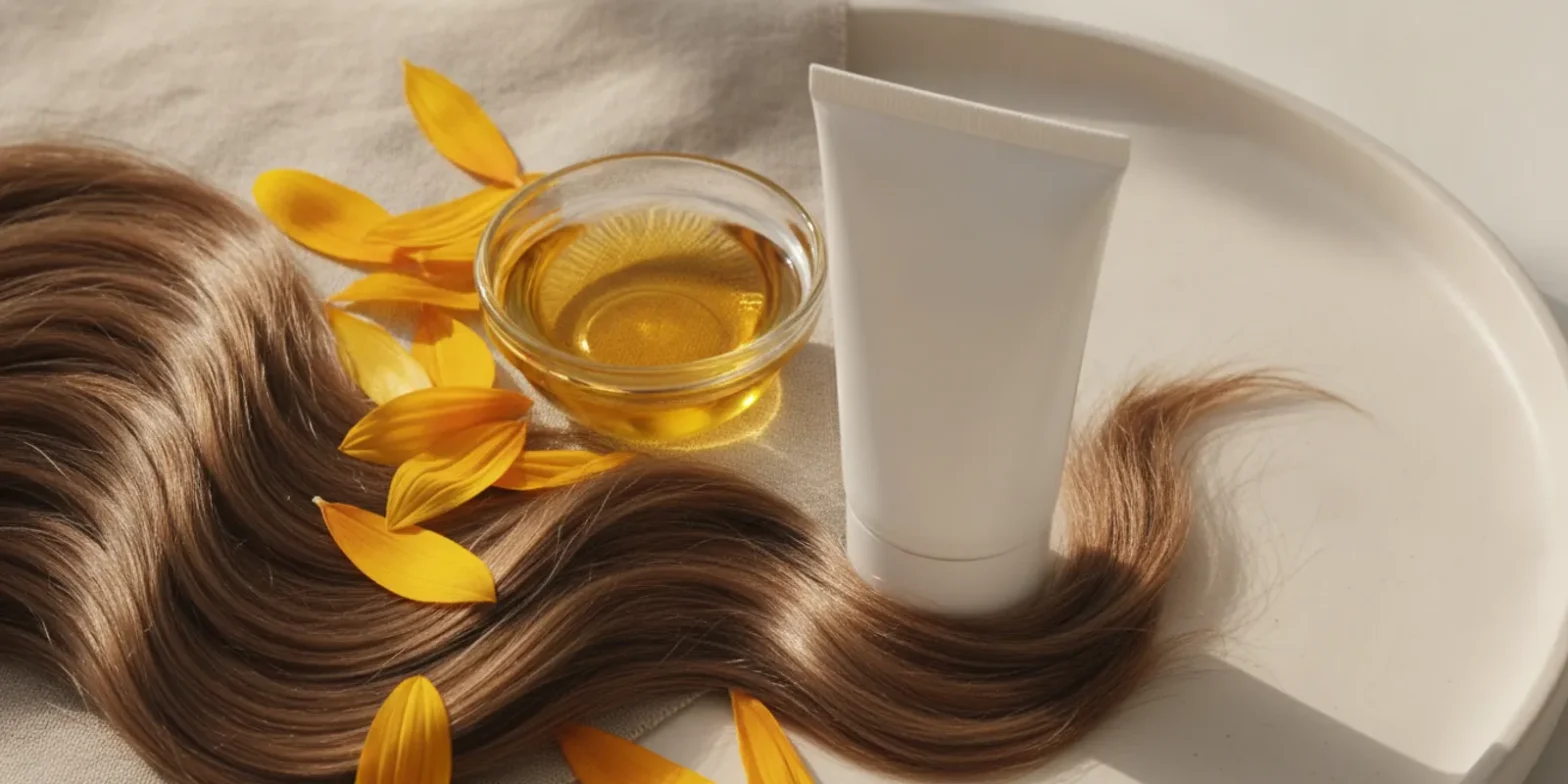
Sunflower oil for hair benefits are best understood as cosmetic support, not a repair miracle. Used in a well-made conditioner or applied sparingly as a finishing oil, it may help hair feel softer and glide more smoothly by reducing surface friction. That can matter after color, when strands may feel rough, dry, or harder to detangle. But sunflower oil cannot undo chemical processing, rebuild every part of a strand, or promise that color will last longer. The full formula and your routine matter more than one ingredient.
Ask Solanesse about post-color care
Sunflower oil for hair benefits: softness, slip, and manageability
In hair care, sunflower oil is mainly valued as an emollient: an ingredient that helps soften the feel of the hair surface. A thin coating can improve slip, making strands feel less rough as they move against one another. With less drag during combing or styling, hair may be easier to manage and less prone to the mechanical stress that comes from tugging at knots.
Those are feel-and-manageability benefits. They are not proof that oil has repaired internal damage. A strand of hair is not living tissue, so a conditioner can improve how it feels and behaves without restoring it to an untouched state. For color-treated hair, that distinction helps set realistic expectations: smoother-feeling hair can be a welcome result even when the underlying history of processing remains.
- Softness: Hair may feel more supple when a formula leaves a light conditioning layer.
- Slip: Better glide can make detangling feel easier and reduce rough handling.
- Surface smoothness: Hair may look more polished when the cuticle surface lies flatter and catches light more evenly.
- Manageability: Less friction can help with combing, styling, and reducing the feeling of flyaways.
Want a conditioner designed around the needs of color-treated hair? Explore the Solanesse hair-care shop.
How does sunflower oil help with softness and friction?
Hair fibers rub against other fibers, comb teeth, towels, clothing, and styling tools. When the surface feels dry or rough, that movement can feel less smooth. A conditioning ingredient that leaves a light film may help strands slide rather than catch. In practical terms, you may notice easier finger-combing, less resistance when brushing, or a softer finish after rinsing and drying.
Sunflower oil is not the only ingredient that can contribute to this effect, and it does not work in isolation in a finished product. The amount used, how it is blended, the other conditioning agents, and the product’s overall texture all affect the result. A rinse-out mask, a leave-in cream, and a finishing oil can contain the same featured ingredient yet behave very differently.
There is also a difference between reduced friction and protection from every kind of damage. A smoother-feeling strand may be easier to handle, but an oil does not make hair immune to heat, chemical processing, tight styles, or forceful brushing. For a broader look at the way treatments support colored hair, see this guide to post-color hair repair.
Notice where the change shows up. If wet lengths feel easier to separate while conditioning, the product may be giving useful slip during detangling. If the ends look glossier after a tiny amount of leave-in product, that is a finish effect. Neither observation alone tells you that the strand has become stronger inside; it tells you how the surface and styling experience have changed.
Friction management is a routine, not a single-ingredient trick. Press water from hair gently instead of rubbing it briskly with a towel, separate knots in small sections, and avoid pulling a brush through a snag. A conditioner that helps the comb move can complement those habits. It cannot replace them, and adding more oil is not necessarily the answer if the real problem is rough handling or a product that is too heavy.
What are the limits of sunflower oil?
Sunflower oil can support a conditioned feel, but it cannot make damaged hair new again. It cannot reconnect split ends, reverse a color service, or guarantee that a strand will not break. A smoother surface can make hair look and feel better; it is not the same as rebuilding the strand’s original structure. If ends are split, trimming is the dependable way to remove the split portion.
Oil is also not a color-depositing ingredient. Do not expect it to correct a shade, neutralize unwanted tones, or replace products specifically made to deposit color. Nor should sunflower oil be treated as a substitute for a complete routine: gentle cleansing, conditioner, careful detangling, and sensible heat use still count.
Finally, more is not always better. Applying a large amount of a pure oil can leave some hair limp, coated, or difficult to rinse. Fine strands may show buildup sooner; textured, dense, or very dry hair may tolerate a richer application differently. Your own results depend on the amount, the formula, and how often you use it. If a product causes irritation or an uncomfortable scalp reaction, stop using it and seek appropriate advice.
How does sunflower oil compare with other conditioning options?
Choosing a hair product by one ingredient name can be misleading. Compare the product format, likely feel, and role in your routine instead. The chart below is a practical guide, not a promise that every formula in a category behaves the same way.
| Option | Typical role | What to expect | What it cannot promise |
|---|---|---|---|
| Sunflower oil in a conditioner | Contributes to a softer, more lubricated feel as part of a blend. | Slip and smoothness shaped by the whole formula. | Repair of internal damage or guaranteed color retention. |
| Pure sunflower oil | Can be used sparingly as a pre-wash or finishing oil if it suits your hair. | A concentrated, potentially heavier feel; start with a small amount. | A balanced rinse-out conditioner experience on its own. |
| Rinse-out conditioner or mask | Conditions lengths after cleansing, often with multiple conditioning ingredients. | Temporary softness and easier detangling after use. | Permanent restoration of processed hair. |
| Leave-in conditioner | Adds ongoing manageability between washes, depending on the formula. | Lightweight or rich feel based on product design and dosage. | Protection from all heat, friction, or chemical stress. |
Use this comparison to decide what role you need filled. If your main issue is a rough feel after rinsing, a rinse-out conditioner may be the more direct fit. If you want a small amount of added glide on dry ends, a finishing product may make sense. For a more detailed look at formula choices, visit Solanesse Science & Ingredients.
Consider two common situations. Hair that feels rough and tangles throughout the lengths after shampooing may benefit more from a rinse-out conditioner with enough slip to distribute through sections. Hair that already feels conditioned but has a few dry-feeling ends may need only a small amount of a leave-in or finishing formula. If a rich product makes the roots look flat or the lengths feel coated, reduce the amount or keep it farther from the scalp rather than layering on another oil.
Texture and density offer clues, but they do not dictate a universal rule. Fine hair can still need conditioning; it may simply respond better to a lighter application. Dense or textured hair may be easier to work through when product is applied in sections, but that does not mean it needs pure oil. Let the after-wash result guide adjustments: softness and movement are useful signs, while persistent residue, limpness, or difficult rinsing suggest changing the dose or format.
Does sunflower oil protect color-treated hair?
Sunflower oil can be part of a conditioning routine for color-treated hair, but it should not be presented as a shield that stops color from fading. Hair color can change for several reasons, and an oil’s presence alone does not establish a color-protection result. Choose products according to their overall purpose and follow their directions rather than assuming one ingredient will preserve every shade.
After coloring, focus on reducing unnecessary stress and keeping hair manageable. Wash according to your needs, avoid rough towel friction, detangle gently, and use heat thoughtfully. A conditioner can improve softness and slip, which may make daily handling easier. It is useful to think of conditioning as support for the feel and care of the hair, not a guarantee against every consequence of processing.
If you are weighing treatment types, this overview of hair bond repair treatments explains why products can take different approaches. You can also read about how to care for hair after coloring for a broader routine perspective.
How should you use sunflower oil in a hair routine?
Start with the product directions. A rinse-out conditioner containing sunflower oil is not used the same way as pure oil or a leave-in product. If trying pure sunflower oil, begin with a very small amount and focus on the lengths or ends rather than saturating the roots. See how your hair feels after washing before deciding whether to use more or repeat the application.
- Identify the goal. Decide whether you want easier detangling, softer ends, or a finishing touch. One product may not solve every concern.
- Apply to the intended area. Many people prefer to keep richer products on the lengths and ends, where dryness is more noticeable, rather than applying heavily to the scalp.
- Use a modest amount. Add more only if needed. Too much can make hair feel coated or reduce volume.
- Detangle gently. Work from the ends upward with fingers or a suitable comb; do not force through knots.
- Adjust based on the result. If hair feels heavy, use less, apply less often, or switch to a lighter formula.
For a post-color ritual, a simple routine is often easier to maintain than layering multiple oils and masks. Cleanse as needed, apply a conditioner suited to your hair, follow the label’s timing, rinse well, then handle wet strands with care. Solanesse’s Deep Conditioner Post-Color Revitalizer is positioned as a single-step at-home treatment for color-treated hair, with a 10-15 minute treatment time. Review its product directions and ingredient information before use.
To tell whether a change is useful, keep the trial simple. Use one new product according to its directions, rather than introducing an oil, mask, and leave-in on the same day. After rinsing and drying, note whether detangling took less effort, whether the ends feel soft without residue, and whether your hair keeps the movement you like. On the next wash, adjust only one variable, such as using a smaller amount or applying it to fewer sections. This makes it easier to identify what your hair responds to.
If your hair is fine or easily weighed down, begin with the smallest recommended amount and apply only where needed. If your lengths are dense or tangle-prone, work in sections so conditioner reaches the areas you want to smooth. Avoid judging a product only while it is wet: feel the dried hair too, since residue and heaviness may become clearer later. Follow the label rather than extending treatment time on the assumption that longer always means better.
Sunflower oil for hair benefits and the evidence behind them
Ingredient evidence and marketing language are not interchangeable. An ingredient can have a plausible cosmetic role, such as helping a formula soften or lubricate hair, without proving that every product containing it produces the same result. The percentage, formulation, directions, and use conditions matter. So do the exact claims being made: “helps hair feel softer” is narrower than “repairs damage” or “prevents fading.”
One web page listed as a government source asks whether sunflower oil is beneficial or harmful for hair and mentions that natural antioxidants can affect its stability. That discussion is not, by itself, proof of a finished product’s performance. See the sunflower oil and hair overview for that framing. The practical takeaway is to assess a specific product and its directions, rather than treating a single ingredient name as a guarantee.
When reading a label, consider the product type, where it should be applied, and whether the claimed result is about feel, appearance, or structural change. For another ingredient-focused perspective, explore how peptide hair treatments are discussed and keratin in care for color-treated hair. These ingredient guides can help you compare roles without assuming that an ingredient alone tells the whole story.
A useful way to read a claim is to ask what could be observed and under what conditions. “Leaves hair feeling smoother after conditioning” describes a short-term cosmetic experience. “Repairs the strand” implies a deeper structural result, while “protects color” suggests a specific outcome over time. Those statements need different kinds of support. The presence of sunflower oil on an ingredient list does not tell you its concentration, how it interacts with the rest of the formula, or whether the finished product has been evaluated for a particular claim.
That is why a product’s directions and purpose matter more than a trend around a single oil. A formula may combine emollients with conditioning agents to create a particular texture and rinse profile. Another formula may use the same named oil in a different amount or format. Evaluate the product you will actually use, and keep expectations focused on results you can assess, such as softness, slip, and ease of combing.
How do you choose a sunflower oil hair product?
Look beyond the front label. Ask how the product fits your routine and whether the claims match what a conditioning ingredient can reasonably do. A hair mask, rinse-out conditioner, leave-in, and pure oil each have different use patterns. The best choice is the one that suits your hair’s feel, your application preferences, and the result you want to support.
- Check whether it is rinse-out, leave-in, or intended for pre-wash use.
- Look for directions that explain how much to use and where to apply it.
- Consider the complete ingredient list and product texture, not just the featured oil.
- Be cautious of absolute promises about repair, color permanence, or guaranteed results.
- Patch test new products as appropriate and stop if you experience irritation.
For color-treated hair, choose a formula made for your needs and use it consistently as directed. Solanesse describes its Deep Conditioner Post-Color Revitalizer as a post-color conditioning ritual with hydrolyzed keratin, collagen, plant-based peptides, sunflower oil, bergamot, and vanilla. The product is priced at $39 for a 4 oz tube; free shipping applies to U.S. orders, and the 30-day satisfaction guarantee applies to first-time buyers. For current product details, review the Solanesse shop before ordering.
Frequently Asked Questions
Can sunflower oil make hair softer?
It may help hair feel softer when used in a suitable formula, partly by contributing to surface lubrication. Results vary with the formula, amount, and your hair. Softness is a cosmetic result, not proof that damage has been reversed.
Can I put sunflower oil directly on my hair?
You can try a small amount if the product is intended for hair and it suits you. Begin on the lengths or ends, use sparingly, and wash it out if your hair feels coated. Follow product directions and discontinue use if irritation occurs.
Will sunflower oil stop hair color from fading?
Do not rely on sunflower oil alone to prevent fading. Its presence in a conditioner does not guarantee color retention. Use a routine designed for color-treated hair and treat oil as a conditioning ingredient, not a color seal.
Is pure oil better than a conditioner with sunflower oil?
Not necessarily. Pure oil offers a concentrated ingredient, while a conditioner combines ingredients and is designed for a particular use. Choose by the result you want, the product directions, and how your hair responds.
Can sunflower oil repair color damage?
It can contribute to a smoother, softer feel, but it cannot reverse chemical processing or permanently repair a damaged strand. For color-treated hair, look for a thoughtfully formulated conditioner and handle strands gently between color services.
Explore a considered post-color conditioning ritual
Make the ingredient work for your routine
Sunflower oil may bring softness, slip, and a smoother-feeling finish when it is part of a formula that suits your hair. Its limits matter just as much: it cannot reverse processing or guarantee lasting color. Focus on the complete product, use it as directed, and let a consistent post-color routine, not a single ingredient, guide your care.


