


Frizz control products for fine colored hair need to smooth the surface without leaving strands limp, coated, or hard to style. The goal is not to pile on moisture: it is to match the product’s weight and hold to where your hair frizzes, then use only enough to control it.
Ask Solanesse about your post-color routine
What should fine, colored hair prioritize?
Fine hair can feel weighed down by rich creams and oils, while color-treated lengths may still feel rough, dry, or flyaway-prone. Those needs can coexist: a strand can be fine in diameter and still need careful conditioning after color. Instead of choosing a product by the word “hydrating” or “anti-frizz” alone, look at its format, where you will apply it, and what finish it leaves behind.
Start with three priorities:
- Low weight: favor a fluid lotion, light conditioner, mist, or flexible gel over a dense butter when volume matters.
- Targeted placement: smooth the mid-lengths and ends first; keep richer products away from the roots unless your scalp and style need them.
- Finish you can live with: decide whether you want soft movement, defined shape, or stronger humidity-resistant hold. One product rarely does every job equally well.
Frizz is not a single product problem. A rough-feeling surface, flyaways from static, humidity-related expansion, and breakage around the hairline can look similar but respond differently to conditioning and styling. Hair-care products also differ in their ingredients and functions; a review of hair cosmetics describes categories such as shampoos, conditioners, straightening products, and dyes, rather than treating all products as interchangeable (NIH review of hair cosmetics).
For a broader look at why color-treated strands may feel different, see Solanesse’s guides to post-color hair porosity and how hair dye can affect hair. Here, the focus is narrower: choosing a frizz-control format that fits fine hair without building up a complicated routine.
Which product formats control frizz without flattening fine hair?
Read the texture and intended use before the marketing promise. A lightweight conditioner can support softness during washing, while a leave-in or styling product can help with slip and surface control after the shower. The right choice depends on when frizz appears and whether your hair needs conditioning, hold, or both.
| Product format | Best fit | Watch for | How to start |
|---|---|---|---|
| Light rinse-out conditioner | Lengths that feel rough after shampooing | Rich formulas that leave roots flat | Apply to lengths, follow label directions, rinse thoroughly |
| Light leave-in lotion or mist | Dry ends or flyaways between washes | Layering too much product with conditioner | Use a small amount on damp lengths, then reassess when dry |
| Flexible gel or styling cream | Frizz that appears as hair dries or loses shape | Stiffness or visible residue from excessive hold | Distribute evenly in sections; use less near the roots |
| Serum or oil | A few dry-looking ends that need a finishing touch | Greasy feel, stringy pieces, or loss of movement | Use a very small amount only on the ends |
| Heat-activated smoothing product | Only when you regularly use the stated styling method | Instructions, heat exposure, and ingredients matter | Follow the label; do not use as a substitute for heat protection |
The table is a starting point, not a promise that every formula in a category will behave the same way. Formulas vary, and a product’s placement instructions matter as much as its texture. The fine-hair conditioner guide and guide to masks for color-damaged hair can help you compare richer conditioning with lighter everyday options.
How can you tell what kind of frizz you are managing?
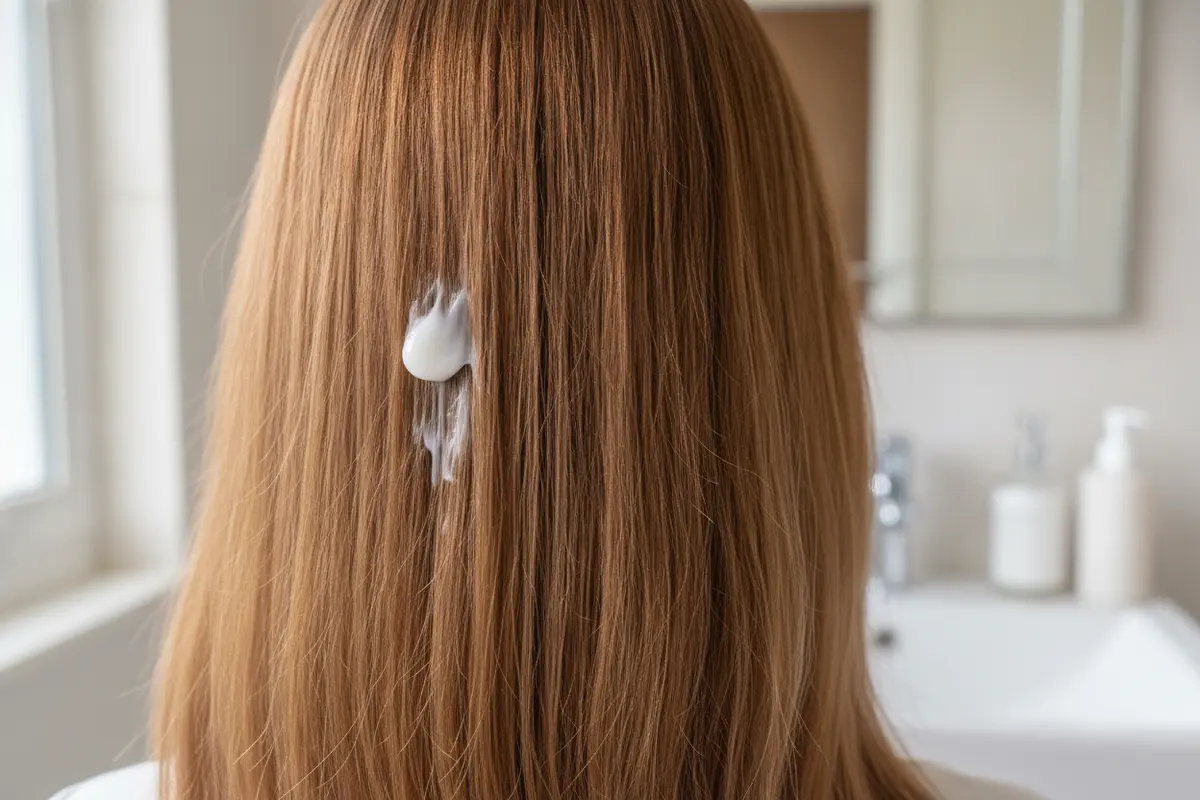
Before buying another bottle, notice when and where the frizz shows up. A quick check can point you toward a more precise product choice.
- Roughness after washing: if lengths feel snaggy or dry once rinsed, begin by reviewing your rinse-out conditioner and how thoroughly you rinse. Avoid adding a heavy finishing layer before you know whether the wash step is leaving the hair uncomfortable.
- Flyaways on dry days: static or friction can create wispy strands. Try a small amount of leave-in on damp ends or a light finishing product on the dry surface, rather than coating the whole head.
- Expansion in humid weather: a flexible styling product may help hold the shape you set. Apply evenly and allow the hair to dry as directed; adding more and more conditioner is not always the answer.
- Frizz concentrated at the ends: focus conditioning there. Split or weathered ends may remain irregular even after styling, so product can help manage their appearance but cannot make damaged ends new again.
- Short hairs around the hairline: these may be new growth or breakage. Avoid aggressively brushing them flat or repeatedly applying product; if breakage is a concern, reduce avoidable friction and high-heat styling.
Use this diagnosis as a practical observation, not a medical assessment. If hair becomes unusually brittle or breakage continues, pause chemical and heat styling and consider asking a qualified hair professional for advice.
How should you compare lightweight, film-forming products?
Many styling products use polymers or other ingredients that leave a film on the strand. That film can help hair hold a shape, feel smoother, or resist disruption during styling. The effect depends on the formula and the way you use it. “Film-forming” is not automatically a synonym for heavy: a light gel used sparingly can feel less weighty than an oil-rich cream. But repeated layers can leave fine hair coated or stiff.
Use these checks when comparing labels and testing a product:
- Match the format to the task. For softness in the wash, start with conditioner. For a style that loses shape, test a flexible styling product. For a few dry ends, a tiny finishing amount may be enough.
- Look for directions that fit your routine. A product used on damp hair, a rinse-out conditioner, and a heat-activated formula are not interchangeable. Follow the product label rather than guessing at timing or application.
- Test a small amount first. Apply it to one section or to the lower lengths. Let hair dry fully and check movement, root lift, residue, and feel before using more.
- Change one product at a time. If you change shampoo, conditioner, leave-in, and styling product together, it is difficult to tell what helped or caused buildup.
- Rinse and reset when needed. If hair starts to feel coated, limp, or dull, simplify the next wash and use products as directed. Do not assume that more layers will create more smoothness.
A comparison study of hair damage-assessment methods discusses how researchers evaluate hair-surface changes under particular test conditions; it does not mean one ingredient or product format will deliver the same result for every person (hair-damage assessment study). Treat claims on a product label as a guide to intended use, then judge the result on your own hair.
What should you check on the label before buying?
Product names are not a reliable substitute for directions. “Smoothing,” “anti-frizz,” and “weightless” can describe a goal, but they do not tell you exactly how a formula will feel on your hair. Check the format, when it should be applied, whether it is rinsed out, and whether it is intended to be used with heat. Those details help you decide if the product fits the moment your frizz appears.
- For a rinse-out product: check how long it should stay on and how thoroughly it should be rinsed. If your hair is easily weighed down, test it on the lengths first.
- For a leave-in: confirm whether it is designed for damp or dry hair. A leave-in is not meant to be rinsed away, so begin with a modest amount and avoid placing it at the roots unless the directions say otherwise.
- For a styler: look for the hold or finish it is intended to provide. A flexible hold may be preferable when you want movement; stronger hold may suit a style that needs more structure.
- For a heat-activated product: read the instructions closely and use only with the stated tool or technique. Do not infer that every smoothing treatment is a heat protectant.
Also consider how products combine. A conditioner, leave-in, styling cream, and finishing serum can each add something to the hair, but using all of them automatically may create more coating than fine lengths need. If you like a richer rinse-out treatment, you might skip the leave-in on that wash and style with a small amount of gel instead. If the wash leaves your hair comfortable, there may be no need to add an oil. This is not a rigid rule; it is a way to keep the routine testable.
Read ingredient lists as information, not as a shortcut to a guaranteed result. A single ingredient name cannot tell you the concentration, the complete formula, or how your hair will respond. Likewise, “natural,” “clean,” or “salon” wording does not establish that a product will be light enough for your hair. If you are sensitive to a particular ingredient, review the full label and follow the maker’s precautions. A hair-cosmetics review is useful background for understanding that products are formulated for different functions; it is not a product-by-product recommendation for your own strands (overview of hair cosmetics).
A simple product test can prevent unnecessary purchases. Choose one wash day, use the product in the stated way, and make a short note after the hair is fully dry: Did the lengths feel soft? Did the roots keep their lift? Did the style hold? Was there residue or an unpleasant feel? Repeat once before deciding if results vary with styling or weather. If you change the amount, keep the other steps the same. That gives you a clearer comparison than switching several products at once.
How do you build a simple routine after coloring?
A compact routine makes it easier to identify what fine, colored hair actually needs. Start with the products you already tolerate, then adjust one step rather than layering multiple new treatments at once.
- Wash gently and condition the lengths. Choose a rinse-out conditioner that leaves the hair comfortable without a coated feel. Concentrate it where hair is longest and most prone to tangling.
- Detangle with care. Work through the lengths gently, starting at the ends. Avoid rough towel rubbing, which can add friction and leave strands looking more unruly.
- Choose one leave-in or styler for the main concern. Use a light leave-in if the lengths feel dry; try a flexible styler if the issue is shape and flyaways as the hair dries. Begin with less than you think you need.
- Dry with the finish in mind. Air-dry or style in a way that suits your hair. If using heat, follow the styling product and tool instructions and avoid excessive heat.
- Review the result when fully dry. If hair feels soft but flat, reduce the amount or move application farther from the roots. If it feels rough, revisit conditioning before adding a heavier finishing layer.
For a conditioning step specifically designed for after color, Solanesse’s Deep Conditioner Post-Color Revitalizer is a single-step, at-home treatment intended to take 10–15 minutes. Its formula includes hydrolyzed keratin, collagen, plant-based peptides, sunflower oil, bergamot, and vanilla; it is described as free from sulfates, parabens, silicones, phthalates, mineral oils, and GMOs. Fine hair can still be weighed down by any treatment if too much is used or it is not rinsed as directed, so follow the product directions and judge the finish. Read the Science & Ingredients information and the post-color repair guide for more context.
Conditioner works on the hair’s surface and feel; it is not a color-correction service. If you use a chemical straightener or smoothing product, read its label and safety information carefully. The FDA warns that some hair-smoothing products release formaldehyde when heated; this is a specific safety issue with certain products, not a reason to assume every conditioner has the same risk (FDA information on hair-smoothing products).
When does a deep conditioner make sense for fine hair?
Fine strands do not automatically need a lightweight-only routine. If the lengths feel dry after color, a rinse-out deep conditioner may be useful as an occasional targeted step. The practical questions are how your hair responds, where you apply it, and whether the finished hair still has the movement you want.
Choose a treatment with a clear role in your routine, and avoid stacking it with several rich masks, oils, and leave-ins on the same day. Follow its stated use time. Solanesse describes its Deep Conditioner Post-Color Revitalizer as a 10–15 minute treatment and a post-color repair ritual. For its current purchase details, see the Solanesse shop; the brand states that U.S. orders ship free, international shipping is unavailable, and its 30-day satisfaction guarantee applies to first-time buyers.
Explore the Deep Conditioner Post-Color Revitalizer
Frequently Asked Questions
Can fine, colored hair use an anti-frizz cream?
Yes, if the formula and amount suit your hair. Start with a small amount on damp mid-lengths and ends, then check the fully dry result. If hair feels coated or loses movement, use less or try a lighter format.
Should I use oil or leave-in conditioner for flyaways?
It depends on the cause and finish you want. A leave-in can add conditioning to damp lengths, while a tiny amount of oil or serum may help smooth a few dry ends. Neither needs to be applied from roots to ends by default.
Can I use a deep conditioner every time I wash?
Follow the product directions and let your hair’s response guide frequency. If fine hair becomes limp or coated, use less, apply only to lengths, rinse thoroughly, or use the treatment less often.
Will frizz-control products prevent color from fading?
Do not assume a product will preserve color unless its directions and substantiated claims say so. A frizz-control product may help with manageability, but color maintenance is a separate concern; see this guide to preventing hair-dye fade for color-care considerations.
Choose less, place it well, and reassess
For fine, colored hair, effective frizz control is a balance of conditioning, placement, and finish. Begin with one lightweight product that fits the problem, use it as directed on the lengths, and let the dry result—not the label’s biggest promise—tell you what to change next.


